


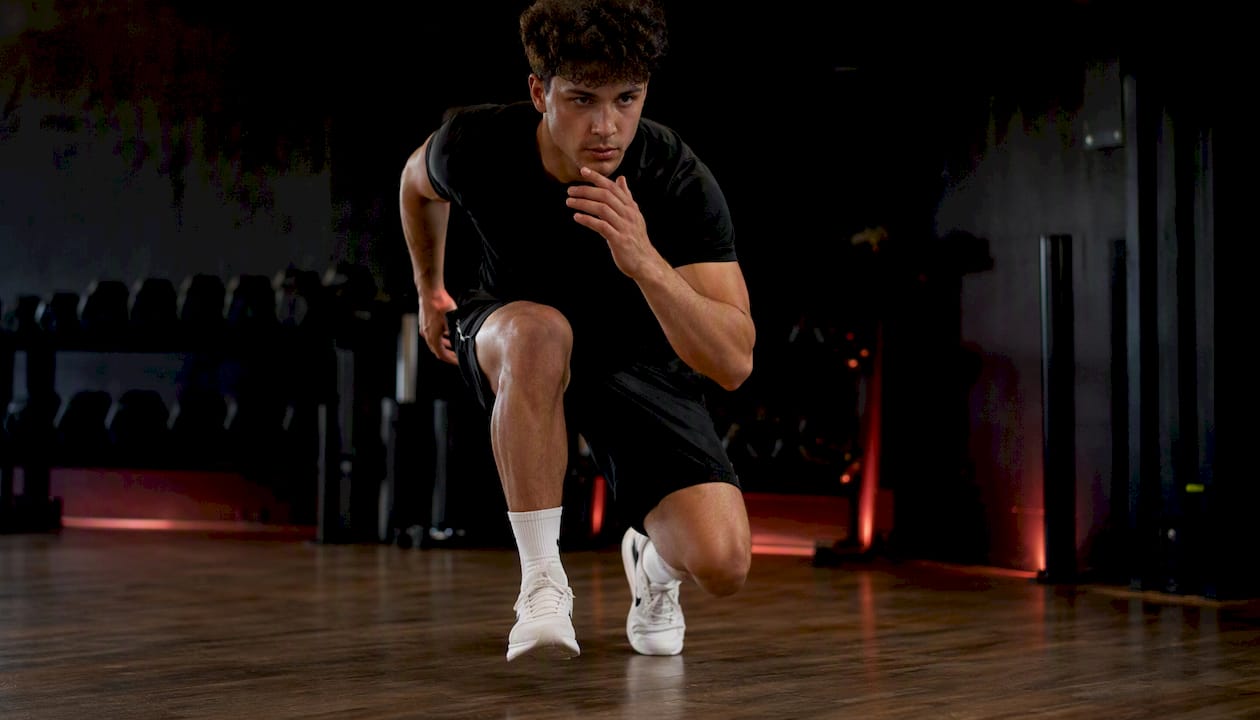
Tennis strength and conditioning (S&C) is sport-specific physical training designed to transfer gym-built qualities directly to court actions: first-step acceleration, change-of-direction speed, rotational power through the serve, and the ability to repeat explosive efforts across a two-hour match. General fitness keeps you healthy; tennis S&C makes you faster, stronger, and harder to beat in the third set.
The five programming priorities that separate a tennis S&C plan from a generic gym program:
- Sport-specific power via plyometrics and medicine-ball rotational throws
- Neuromuscular control for agility and landing mechanics
- Single-leg strength to mirror the asymmetric demands of court movement
- Shoulder health through daily prehab and scapular control work
- Load management across the competitive calendar (off-season, pre-season, in-season)
A well-designed program is built in three phases. Off-season blocks build capacity and correct asymmetries. Pre-season shifts toward power and speed. In-season work maintains qualities without accumulating fatigue. Testing every 6–12 weeks with a five-test battery (20 m sprint, countermovement jump, lateral bound, forearm plank, shoulder mobility screen) tells you whether the program is working.
Key Takeaways
A well-designed tennis S&C program built around plyometrics, neuromuscular training, single-leg strength, and load-managed periodization produces measurable gains in serve speed, sprint time, and late-match durability.
| Point | Details |
|---|---|
| Test before you train | Run the five-test battery (20 m sprint, CMJ, lateral bound, plank, shoulder screen) before starting any new program phase. |
| Prioritize plyometrics and neuromuscular work | These modalities produce the largest gains in power, speed, and agility for tennis players across the evidence base. |
| Match volume to the season | Use 3–4 gym sessions in the off-season, drop to 2 in-season, and cut to activation-only during tournament weeks. |
| Manage load proactively | Track session RPE, jump symmetry, and wellness scores weekly; deload every fourth week regardless of how good the player feels. |
| Bodiesbymahmood | Offers sport-specific assessment, seasonized programming, and on-site rehab for tennis players in Orlando. |
Table of Contents
- What tennis strength and conditioning actually means
- Key benefits: what a proper S&C program delivers
- When to start S&C and how age changes the approach
- Primary components every tennis S&C program needs
- Season-based programming: what to do and when
- Specific exercises and progressions for each component
- On-court conditioning: training repeated-sprint ability
- Injury prevention and load management
- Field tests and metrics to track progress
- Programming principles and what the evidence actually says
- What most coaches get wrong about tennis S&C
- Sport-specific training at Bodiesbymahmood in Orlando
- Sources
What tennis strength and conditioning actually means
Tennis S&C is training engineered to improve the physical qualities that determine match outcomes, not just general athleticism. The distinction matters because tennis movement is nothing like a steady jog or a barbell squat. Every point demands a rapid first step, a lateral bound or split-step, a deceleration into a groundstroke, and then an immediate reset. A player who can sprint 5 m in 0.9 seconds and absorb landing forces cleanly will consistently reach balls that a stronger but less explosive opponent cannot.
The kinetic chain is the organizing principle behind every exercise choice. According to NSCA guidance, the core is the primary link in that chain: it transfers force from the ground through the trunk and into the racket. A weak trunk creates power leaks at the serve and raises injury risk during high-speed groundstrokes. That is why rotational core training is not optional; it is the mechanism that connects lower-body power to racket-head speed.
The movement patterns a tennis S&C program must train:
- Triple extension (ankle, knee, hip) for explosive push-off and serve loading
- Single-leg push and deceleration for lateral reach and recovery steps
- Lateral bounds and crossover steps for wide-ball coverage
- Rotational throws and anti-rotation holds for serve and groundstroke power transfer
Training surface also shapes adaptation. Hard surfaces favor power development; sand training tends to improve strength, balance, and speed simultaneously. Matching surface to the desired adaptation is a detail most recreational programs overlook.
Key benefits: what a proper S&C program delivers
The performance gains from a well-run tennis S&C program are measurable, not theoretical. Faster 5–20 m sprint times, a higher countermovement jump, increased serve velocity, improved change-of-direction time, and better fatigue resistance in the final set are all outcomes coaches can test and track.
A 2024 systematic review of 18 studies found that plyometric, neuromuscular, and functional training each produced statistically significant improvements in strength, speed, power, agility, and dynamic balance in adolescent tennis players. HIIT improved endurance but showed limited effect on agility. Resistance training increased power and serve speed.
Stat to know: A 2025 meta-analysis across 23 randomized trials with 743 participants found large standardized mean differences for service velocity and power with neuromuscular training modalities, with plyometric training ranking especially high for both.
Durability benefits are just as concrete:
- Shoulder resilience from rotator-cuff prehab and scapular control work
- Reduced overuse risk through load management and progressive volume increases
- Better landing mechanics to protect knees and ankles during split-steps and lateral lunges
- Lower back protection from anti-rotation core strength and hip mobility
The performance-to-play connection is direct. A stronger first step means you reach more balls. A higher CMJ means more net clearance on the serve. Better late-match conditioning means your groundstroke mechanics hold up in the third set when your opponent’s are falling apart.
When to start S&C and how age changes the approach
The right time to start S&C is earlier than most coaches think, but the content changes dramatically by age and level. Throwing a 12-year-old into a barbell program is a mistake; so is waiting until college to introduce any physical training beyond hitting balls.
Age-banded guidance:
- Under 12: Movement literacy first. Emphasis on coordination, balance, and basic jumping and landing patterns. Bodyweight training builds the foundation without loading immature joints.
- Ages 12–17: Progressive resistance using bodyweight, bands, and light loads. Introduce single-leg strength, rotational medicine-ball work, and low-volume plyometrics. Frequency: 2 gym sessions per week alongside 4–5 on-court days.
- Ages 18+ and adult competitors: Targeted power and speed work, heavier resistance training, and full plyometric progressions. Frequency: 3–4 gym sessions per week in the off-season, dropping to 2 in-season.
- Return-to-play: Begin with isometric holds and controlled single-leg work before reintroducing plyometrics. Isometric training is particularly useful here for joint protection during heavy court cycles.
For college-bound juniors, the 12-week Foundation/Build/Sharpen templates and age-banded field test targets give coaches a structured way to set benchmarks and track progress toward recruitment-level standards.
Pro Tip: The most common mistake in junior tennis S&C is training like a bodybuilder. Isolation exercises and maximum hypertrophy have almost no transfer to court speed. Prioritize elastic energy transfer, landing mechanics, and deceleration competency. A player who can “stick the landing” cleanly after a lateral bound is far less likely to roll an ankle than one who can leg-press twice their bodyweight.
Primary components every tennis S&C program needs
A complete tennis S&C program draws from six training modalities. Each one targets a different physical quality, and the order you sequence them within a session matters as much as the exercises themselves.
The six core components:
- Lower-body strength with a single-leg emphasis (split squats, single-leg deadlifts, lateral step-ups)
- Rotational core and anti-rotation (Pallof press, cable chops, medicine-ball rotational throws)
- Upper-body and shoulder health (rotator-cuff prehab, scapular control, overhead medicine-ball throws)
- Plyometrics and power (bounding, box jumps, lateral hops, resisted sprints)
- Agility and change-of-direction (ladder drills, reactive cone work, split-step patterns)
- Repeated-sprint conditioning (short-interval court sprints, shuttle patterns)
The functional training component ties these together by training movement patterns rather than isolated muscles.
| Modality | Primary adaptation | Best use in a tennis program |
|---|---|---|
| Plyometrics | Power, short-sprint speed | Off-season and pre-season power blocks |
| Neuromuscular training | Agility, service velocity | Year-round; especially pre-season |
| Resistance training | Maximal strength, serve speed | Off-season base-building |
| HIIT | Aerobic endurance | Pre-season conditioning; not primary in-season |
| Functional/movement training | Balance, coordination, transfer | All phases; especially youth |
| Mobility and soft-tissue work | Range of motion, recovery | Daily; integrated into warm-up and cool-down |
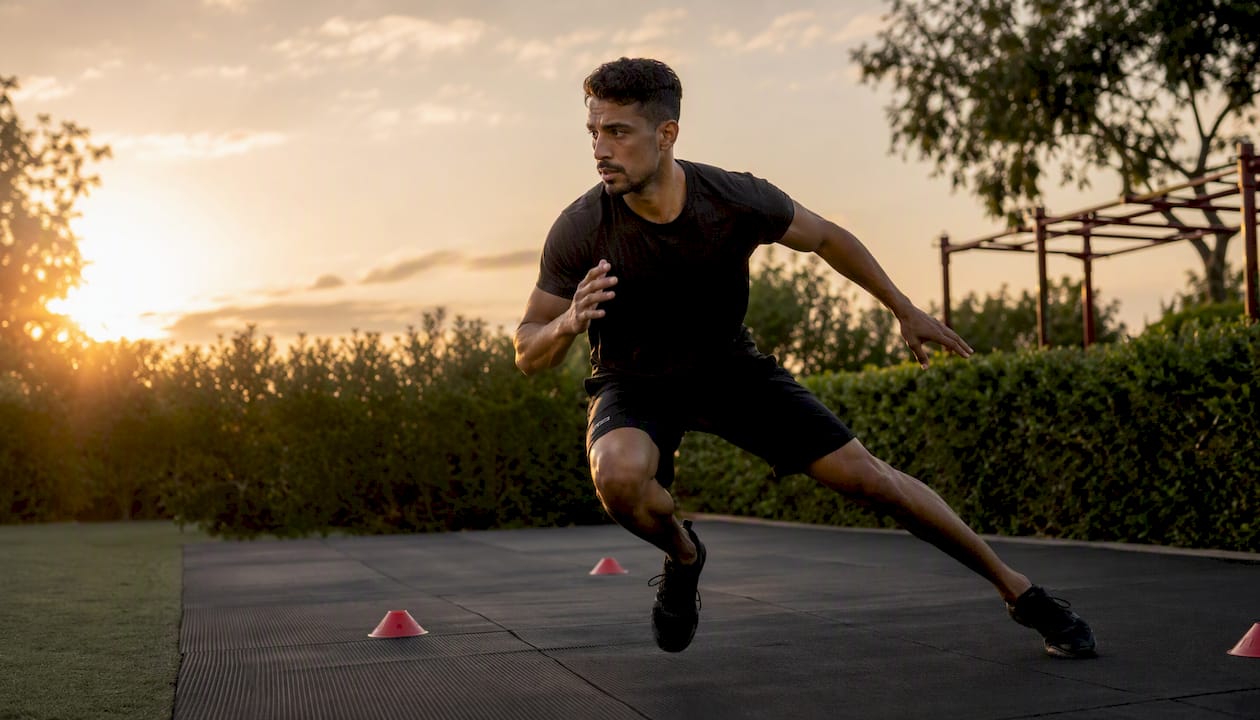
Sequencing rule: Always run neuromuscular and plyometric work before heavy strength in a session. Fatigued neuromuscular tissue cannot produce the fast-twitch output that makes plyometrics effective, and attempting heavy squats after explosive work increases injury risk. The order is: movement prep → plyometrics/power → strength → conditioning → mobility.
Pro Tip: Two sessions per week of targeted neuromuscular training can outperform three for sprint improvements in some youth populations. More frequency is not always better. Monitor session RPE and jump symmetry weekly — if scores drop, reduce volume before adding sessions.
Season-based programming: what to do and when
Periodization is what separates a tennis S&C program from random gym work. The annual plan divides into three phases, each with a different physical emphasis and a different relationship between gym time and court time.
Off-season (8–12 weeks)
The goal is capacity: build a strength base, correct left-right asymmetries, and develop the aerobic foundation that supports later power work. Volume is high; intensity is moderate.
Sample weekly layout:
- Monday: Lower-body strength (squats, single-leg deadlifts, hip hinge)
- Tuesday: On-court technical work (low intensity)
- Wednesday: Upper-body strength + rotational core
- Thursday: Conditioning (aerobic intervals, 20–30 min)
- Friday: Full-body power + plyometrics (low volume)
- Saturday: On-court technical work
- Sunday: Recovery (mobility, soft tissue)
Pre-season (4–6 weeks)
Shift from volume to intensity. Introduce higher-velocity plyometrics, resisted sprints, and on-court conditioning circuits. Gym sessions drop to 3 per week; on-court sessions increase.
A phased preseason structure, supported by collegiate S&C literature, progresses from endurance to strength to power across successive weeks. The final two weeks before competition focus on speed and reactive work with reduced volume.
In-season (tournament blocks)
Maintenance is the priority. The goal is to preserve the qualities built in the off-season without accumulating fatigue that bleeds into match performance.
| Phase | Gym sessions/week | On-court sessions/week | Primary focus | RPE target |
|---|---|---|---|---|
| Off-season | 3–4 | 2 | Strength, capacity, asymmetry correction | 6–8/10 |
| Pre-season | 3 | 4–5 | Power, speed, on-court conditioning | 7–9/10 |
| In-season (light week) | 2 | 5–6 | Maintenance, recovery, speed primers | 5–7/10 |
| In-season (tournament week) | 1 | Match + practice | Activation only; no new loading | 4–5/10 |
Match-week template:
- 5–4 days out: Full maintenance session (strength + short plyometrics, 45 min)
- 2 days out: Short activation session (movement prep, 3–4 explosive sets, 20 min)
- Match day: Dynamic warm-up only; no loading
Specific exercises and progressions for each component
Lower-body strength
Start with bilateral patterns before loading single-leg work. A logical progression:
- Goblet squat (2 × 12, controlled tempo 3-1-1)
- Romanian deadlift (3 × 8, 3-1-2 tempo)
- Rear-foot elevated split squat (3 × 8 each leg)
- Single-leg Romanian deadlift (3 × 6 each leg, add load when form is consistent)
Increase load by 5% per week when the player completes all reps with clean mechanics. If form breaks, hold the load for one more week before progressing.
Plyometrics and power
Jump training for tennis is about quality, not volume. Land every rep before loading the next one.
- Weeks 1–3: Box step-down (landing mechanics focus), broad jump (2 × 5)
- Weeks 4–6: Lateral bound with stick (3 × 4 each side), countermovement jump (3 × 4)
- Weeks 7–9: Resisted lateral bound, drop jump to broad jump (2 × 4)
- Weeks 10–12: Reactive bounding, lateral bound to sprint (2 × 3 each side)
Cue: “Stick the landing for two seconds before the next rep.” Deceleration competency reduces ankle and knee injury risk more than maximizing jump height.
Upper-body and shoulder health
Professional players like Djokovic and Alcaraz rely heavily on rotational medicine-ball work and targeted shoulder maintenance to sustain serve speed across long seasons. A practical shoulder prehab sequence:
- Band external rotation: 3 × 15 each arm (daily)
- Face pull: 3 × 15 (3 times per week)
- Scapular wall slide: 2 × 10 (daily)
- Overhead medicine-ball throw (kneeling): 3 × 6 (twice per week, pre-season and off-season)
Core anti-rotation
The kinetic chain research makes the case clearly: trunk stability is not about crunches. Progress from static holds to loaded rotational patterns:
- Forearm plank (30–60 s holds)
- Pallof press (3 × 10 each side, 2-second pause)
- Half-kneeling cable chop (3 × 8 each side)
- Standing rotational cable chop (3 × 8 each side, add load progressively)
Pro Tip: Tempo matters more than load for core anti-rotation work. A slow, controlled Pallof press with a 3-second pause at full extension builds more trunk stiffness than a fast, heavy one. Stiffness under control is what transfers to the serve.
On-court conditioning: training repeated-sprint ability
Match fitness is not aerobic fitness. A tennis point lasts 4–10 seconds; the rest between points runs 20–25 seconds. That ratio defines the energy system you need to train. Steady-state jogging does not replicate it.
Tennis-specific circuit workouts using short intervals and tennis-like movement patterns improve speed, agility, conditioning, and explosiveness. The recommendation is 2–3 circuit sessions per week outside heavy match blocks, with sessions running 20–45 minutes.
Drill examples:
- Short-court shuttle: Sprint baseline to service line and back, 6 reps, 15 s rest between reps, 2 min rest between sets
- Defensive slide-to-sprint: Lateral slide 3 m, then sprint 5 m forward; 8 reps per set
- Reaction-ball first-step: Drop a reaction ball, sprint to catch it before the second bounce; 10 reps
- Medicine-ball slam to sprint: Slam, then sprint 5 m forward; 6 reps
Work/rest templates that mirror match demands:
- 6 × 10 m sprints with full walk-back recovery (mimics point effort)
- 30 s on / 25 s off × 8 rounds (lateral shuffles and split-steps)
- Repeated-sprint set: 8 × 6 s sprint, 20 s rest between reps, 3 min rest between sets
The warm-up before any conditioning session should include dynamic movement prep: leg swings, lateral shuffles, and 3–4 progressive acceleration runs. Skipping this step is where most soft-tissue injuries happen.
Combining gym and court sessions: Never schedule a heavy plyometric gym session the day before a high-intensity on-court conditioning session. The interference effect is real: fatigued legs produce slower first steps and worse landing mechanics. Separate power gym days from high-intensity court days by at least 24 hours.
Injury prevention and load management
The four injury sites that end tennis seasons are the shoulder, elbow, lower back, and knees. Each one has a specific prevention protocol, and each one responds to load management.
Shoulder care checklist (daily):
- Band external rotation: 2 × 15 each arm
- Face pulls: 2 × 15
- Scapular wall slide: 2 × 10
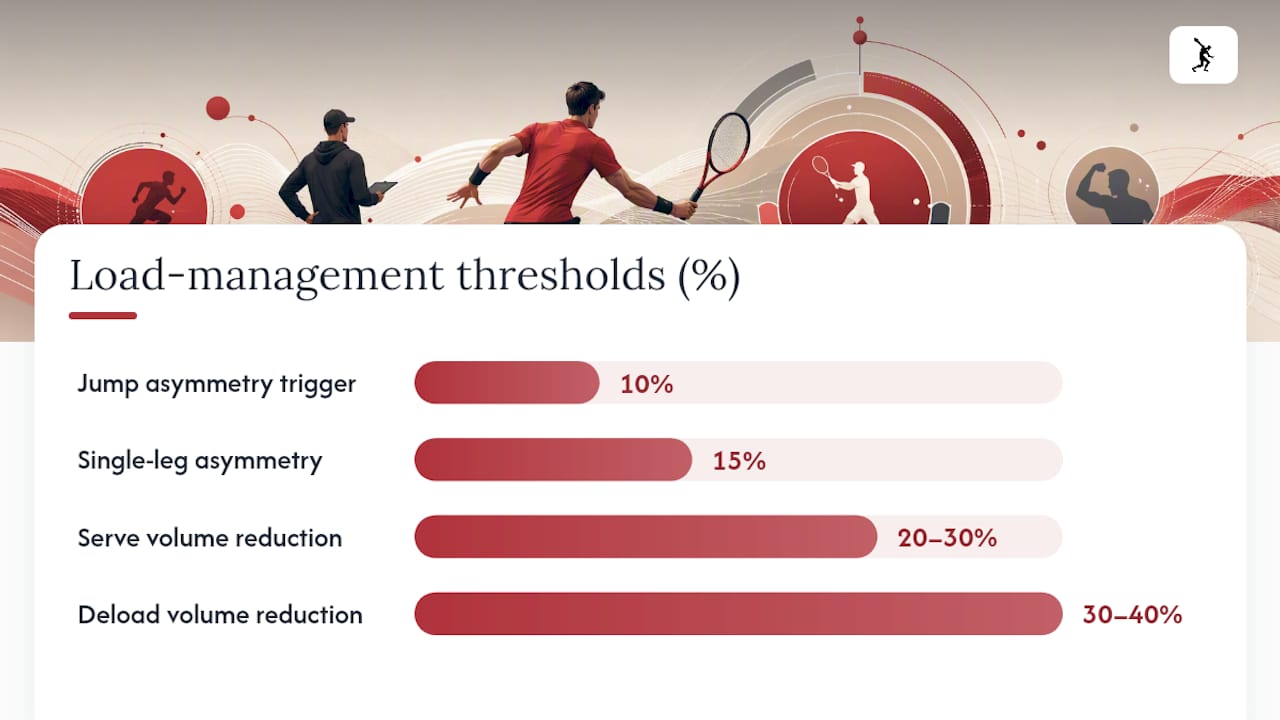
- Reduce serve volume by 20–30% during any week where shoulder soreness rates above 4/10
Lower limb checks:
- Test single-leg squat mechanics monthly. If the knee caves inward more than 10 degrees, reduce plyometric volume and add glute-activation work before the next session.
- Asymmetry threshold: if one leg produces more than 15% less force than the other on a single-leg hop test, address the deficit before progressing loading.
Load management stat: A 2025 meta-analysis found that training frequency moderated outcomes in neuromuscular training programs, with age-specific responses suggesting that more volume is not universally better. Individual monitoring matters more than following a generic volume prescription.
Monitoring tools:
- Wellness questionnaire: Rate sleep, soreness, mood, and energy (1–5 scale) before each session. Three consecutive low scores trigger a deload.
- Jump asymmetry test: Bilateral countermovement jump versus single-leg hop. A drop of more than 10% from baseline signals accumulated fatigue.
- Session RPE tracking: Target RPE 6–8 in off-season, 7–9 in pre-season, 5–7 in-season. Sustained RPE above target without planned overreach = reduce load.
- Deload rule: Every fourth week, reduce volume by 30–40% while maintaining intensity. This is not optional; it is when adaptation consolidates.
Pro Tip: Elbow issues in tennis players almost always trace back to shoulder dysfunction or poor kinetic chain sequencing, not just overuse of the forearm. Before adding forearm-specific work, check scapular control and rotator-cuff strength. Fix the chain, not just the symptom.
Field tests and metrics to track progress
Testing is what turns a training program into a feedback loop. Without it, you are guessing whether the work is transferring to court performance. The five-test battery below covers acceleration, power, lateral symmetry, trunk endurance, and shoulder mobility. Retest every 6–12 weeks, or at the start of each new training phase.
| Test | What it measures | Protocol | Meaningful improvement |
|---|---|---|---|
| 20 m sprint | Acceleration and linear speed | Timed from standing start; best of 2 attempts | Reduction of 0.1 s or more |
| Countermovement jump (CMJ) | Lower-body power and elastic strength | Hands on hips, max effort; average of 3 jumps | Increase of 2 cm or more |
| Lateral bound (each leg) | Single-leg power and left-right symmetry | Max horizontal bound; 3 attempts each side | Symmetry within 10%; distance increase of 5 cm |
| Forearm plank hold | Trunk endurance | Timed hold to form failure | Increase of 10 s or more |
| Shoulder mobility screen | Overhead range and asymmetry | Reach behind back (both arms); measure gap | Symmetry within 3 cm; full overhead range |
For sport performance testing protocols and interpretation guidance, a structured approach to running and reading these tests makes the difference between data that drives decisions and numbers that sit in a spreadsheet.
Testing rules:
- Always test at the same time of day, after the same warm-up protocol
- Never test within 48 hours of a heavy training session or match
- Use the results to set the next phase’s training priorities, not just to confirm progress
Programming principles and what the evidence actually says
The research on tennis S&C is now substantial enough to give coaches clear modality rankings. A 2024 systematic review and a 2025 meta-analysis together cover more than 40 studies and 700+ participants. The headline findings:
- Plyometrics and neuromuscular training produce the largest gains in power, speed, agility, and dynamic balance
- Resistance training is the strongest driver of maximal strength and serve velocity
- HIIT improves endurance effectively but has limited impact on agility or balance
- Functional training improves coordination and movement quality across all age groups
- Training blocks longer than 12 weeks produce larger and more durable adaptations than shorter interventions
Implementation rules drawn from the evidence:
- Prioritize plyometrics and neuromuscular work in every phase; do not drop them in-season
- Run neuromuscular work before strength in the same session
- Two targeted neuromuscular sessions per week can match or exceed three sessions for sprint gains in youth players; recovery quality determines the ceiling
- Blocks under 8 weeks rarely produce lasting power adaptations; commit to the full cycle
One honest limitation: most studies use adolescent or collegiate populations, and group-level averages mask individual variation. A 16-year-old who responds strongly to twice-weekly plyometrics may plateau at that frequency while a teammate needs three sessions. Use the research to set starting parameters, then adjust based on individual testing data every 6–8 weeks.
What most coaches get wrong about tennis S&C
The biggest error I see in tennis S&C programs is treating the gym as the primary training environment. It is not. The gym builds physical qualities; the court is where those qualities get expressed and refined. When gym volume crowds out court time, players get stronger but slower in their tennis-specific movement patterns. The physical qualities never fully transfer.
The second mistake is chasing serve speed before the kinetic chain is stable. A player with a weak core and poor scapular control who adds plyometric loading to their serve will generate more force, but it will leak through the trunk and load the shoulder instead of reaching the racket. The result is a slightly faster serve and a significantly higher injury risk. Movement quality before load is not a beginner principle; it is a professional one.
At Bodiesbymahmood, the approach is to assess movement quality first, build the kinetic chain from the ground up, and only then layer in power work. That sequence takes longer in the first 4–6 weeks, but it produces adaptations that hold up under tournament pressure. Players who skip that foundation phase tend to plateau or get hurt right when the season gets serious.
The third thing coaches underestimate is the psychological side of S&C. Consistent training builds more than physical capacity; it builds the confidence that comes from knowing you have prepared for the physical demands of a long match. That mental edge shows up in the third set.
Sport-specific training at Bodiesbymahmood in Orlando
Bodiesbymahmood gives tennis players in Orlando a direct path from the principles in this article to a program built around their specific test results, playing schedule, and physical gaps. The facility’s 25+ years of sport-specific training experience means your program is not adapted from a generic template; it is built from your CMJ score, your sprint time, your shoulder asymmetry, and your tournament calendar.

Every athlete goes through an initial assessment covering the five-test battery described above. From there, the training plan maps directly to your season phase: off-season capacity work, pre-season power development, or in-season maintenance with load management around match weeks. Physical therapy and sports rehab are available on-site for shoulder, elbow, and knee issues, so you do not have to pause training to address an overuse problem.
Book a sport-specific training session to start with an assessment and get a program that matches your court demands and your calendar.
Sources
- Physical training modalities for adolescent tennis players: A systematic review and meta-analysis
- Effects of neuromuscular training on tennis players: a systematic review and meta-analysis
- Kinetic chain and core training considerations for tennis
- 2026 Tennis Strength Standards and 12-Week Plans for All Ages