


If you’re searching for loudounsportstraining.com alternatives, the short answer is this: the strongest options fall into four categories — hospital-affiliated performance labs, coach-marketplace networks, multidisciplinary private studios, and integrated personal training facilities. Which one fits you depends almost entirely on your top two priorities.
Here’s the fast breakdown:
- College-bound athletes → hospital-affiliated or credentialed performance labs (CSCS staff, objective testing, documented progress)
- Shooting-focused skill work → specialized basketball studios with Dr. Dish or equivalent shooting-machine access
- Injury-managed development → programs with on-site or partner physical therapy and movement screening
- Budget-conscious or local options → coach-marketplace networks and community performance studios
TL;DR: Before booking anything, ask every provider for three things: staff credentials (CSCS or PT license), a sample baseline testing report, and their trial or refund policy. Those three requests will separate serious programs from general gyms faster than any website review.
Table of Contents
- What do Loudoun Sports Training alternatives actually offer?
- Profiles of the top alternatives and how they compare to LST’s services
- How do you choose between LST and its alternatives?
- Why credentialed, multidisciplinary teams produce better results
- Key Takeaways
- What most athletes get wrong when picking a training program
- Bodiesbymahmood: a direct alternative for athletes who want individualized training
- Sources and further reading
What do Loudoun Sports Training alternatives actually offer?
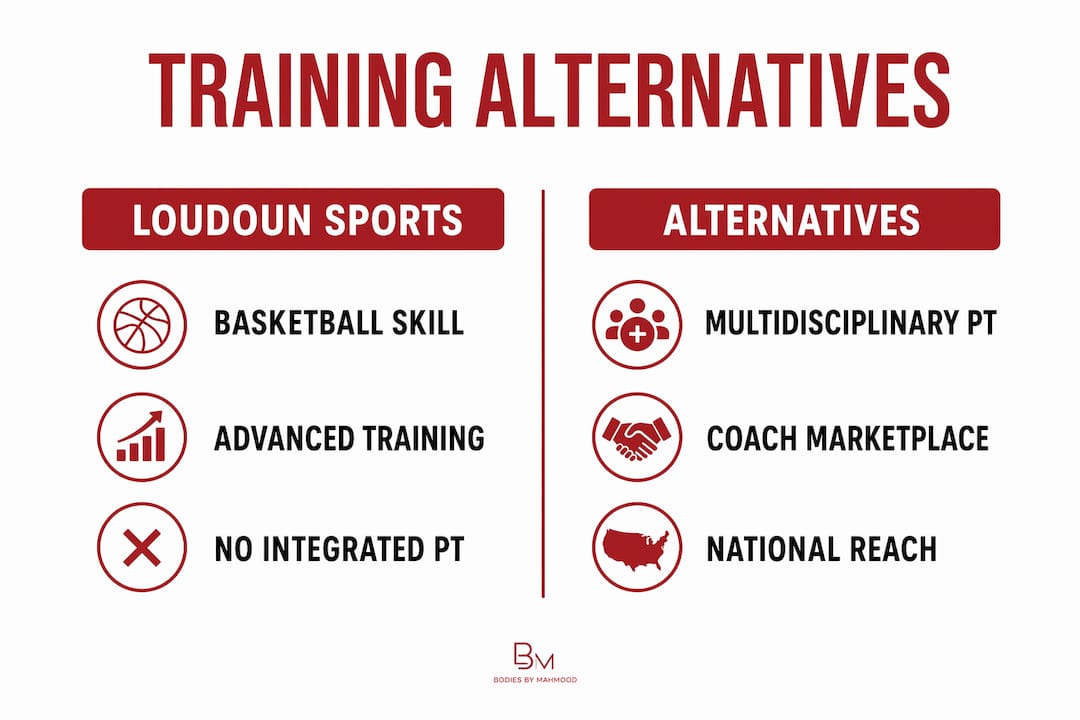
The table below maps the key evaluation dimensions across Loudoun Sports Training and the main alternative categories. Use it to spot gaps and matches for your specific situation.
| Dimension | Loudoun Sports Training (LST) | Hospital-Affiliated Labs | Coach Marketplace Networks | Multidisciplinary Private Studios | Integrated Personal Training |
|---|---|---|---|---|---|
| Best for | Youth to advanced basketball, skill + jump training | Elite/college-bound, injury history | Budget-flexible, local 1-on-1 | Strength + conditioning + PT integration | Individualized performance, all ages |
| Delivery model | 1-on-1, group skills, Vertimax, shooting machine | 1-on-1, semi-private (2–4), team | Private or small-group, coach-matched | Small group, 1-on-1, team | 1-on-1, small group, in-person |
| Typical pricing shape | Per-session, program packages | Per-session or package; premium tier | Per-session, pay-as-you-go | Package or membership | Per-session or membership |
| Facility & equipment | Indoor court, Vertimax, Dr. Dish shooting machine | Performance lab, turf, medical equipment | Coach-dependent, varies by location | Turf, strength equipment, PT suite | Strength equipment, performance testing |
| Coach credentials | Basketball-specific coaches | CSCS + physical therapists, sports medicine | Vetted coaches, credentials vary | CSCS, PT collaboration | CSCS, professional sports background |
| Progress tracking | Evaluation + consultation at program start | Pre/post assessments, objective metrics | Varies by coach | Pre/post assessments, periodic testing | Baseline testing, individualized plans |
| Geographic availability | Leesburg, Virginia (in-person only) | Regional (Northern Virginia / hospital system) | National, flexible location | Regional or local | Orlando, FL; in-person |
Pro Tip: When comparing pricing shapes, calculate cost per coached hour, not cost per session. A 90-minute group session at a lower headline price can cost more per coached minute than a focused 45-minute 1-on-1 if the coach-to-athlete ratio is 1:8.
The two credentials that matter most when vetting any program are CSCS (Certified Strength and Conditioning Specialist, awarded by the NSCA) and a physical therapy license. Programs that pair both tend to adapt training when an athlete’s body signals a problem, rather than pushing through it.
Profiles of the top alternatives and how they compare to LST’s services
What Loudoun Sports Training provides
LST’s core offering, as listed on its services page, covers basketball skill development from fundamental to advanced levels, Vertimax jump training, shooting machine sessions using Dr. Dish technology, and an Elite Level Training Program (ELTP) that begins with a formal evaluation and consultation. Group formats include Game Ready Skills Training. The facility is in Leesburg, Virginia, and serves youth through advanced players.
That’s a strong, basketball-specific stack. The gap for some athletes is the absence of integrated physical therapy and the geographic constraint.
Inova Sports Performance (Healthy Baller)
Inova Sports Performance is the clearest Northern Virginia alternative for athletes who need medical integration alongside performance training. The program offers 1-on-1, semi-private groups of 2–4 athletes, and team performance training, with direct access to orthopedic surgeons and physical therapists on staff. That’s not a marketing claim — it’s a structural feature of being housed within a hospital system.
- Best for: Athletes with injury history, college-bound players who need documented performance metrics, parents who want medical oversight
- Delivery: 1-on-1, semi-private, team
- Standout feature: Multidisciplinary staff including medical specialists — a meaningful differentiator from standalone basketball gyms
- Limitation: Less basketball-skill-specific than LST; stronger on the conditioning and rehab side
Athletes Untapped (coach marketplace, Loudoun County)
Athletes Untapped connects athletes with vetted private coaches for strength, speed, and sport-specific training in Loudoun County and across Virginia. The marketplace model means you pick a coach, not a facility, which gives you flexibility on location, schedule, and price. Coaches design personalized programs covering power, sprint form, and injury prevention.
- Best for: Multi-sport athletes, budget-flexible families, athletes who want to vet a specific coach before committing
- Delivery: Private 1-on-1 or small group, coach-matched
- Standout feature: Pay-as-you-go structure; no long program commitment required upfront
- Limitation: No shared facility with shooting machines or Vertimax; equipment access depends on the individual coach
Norton Sports Performance (SPORTready program)
Norton Sports Performance runs a youth-focused program called SPORTready that includes pre- and post-assessments, coach-led sessions grouped by skill level, and a multidisciplinary staff that brings in sports medicine physicians and nutrition consulting. The assessment cadence is a genuine differentiator: athletes see objective data at the start and end of each program block, which keeps motivation high and gives parents something concrete to evaluate.
- Best for: Youth athletes who need structured skill grouping and documented progress; families who want nutrition and sports medicine access in one place
- Delivery: Coach-led group classes, packages
- Standout feature: Pre/post assessments built into the program structure, not offered as an add-on
- Limitation: Based in Louisville, Kentucky — not a local Northern Virginia option, but relevant as a model for what to look for regionally
Multidisciplinary private studios (integrated PT model)
Facilities that combine CSCS-certified strength coaches with on-site physical therapists represent the gold standard for serious athlete development. Programs that regularly report objective markers — speed, strength, agility, jump height — help athletes see measurable gains, which supports both retention and motivation. The key operational feature is that the PT and the strength coach talk to each other about your athlete, rather than operating in separate silos.
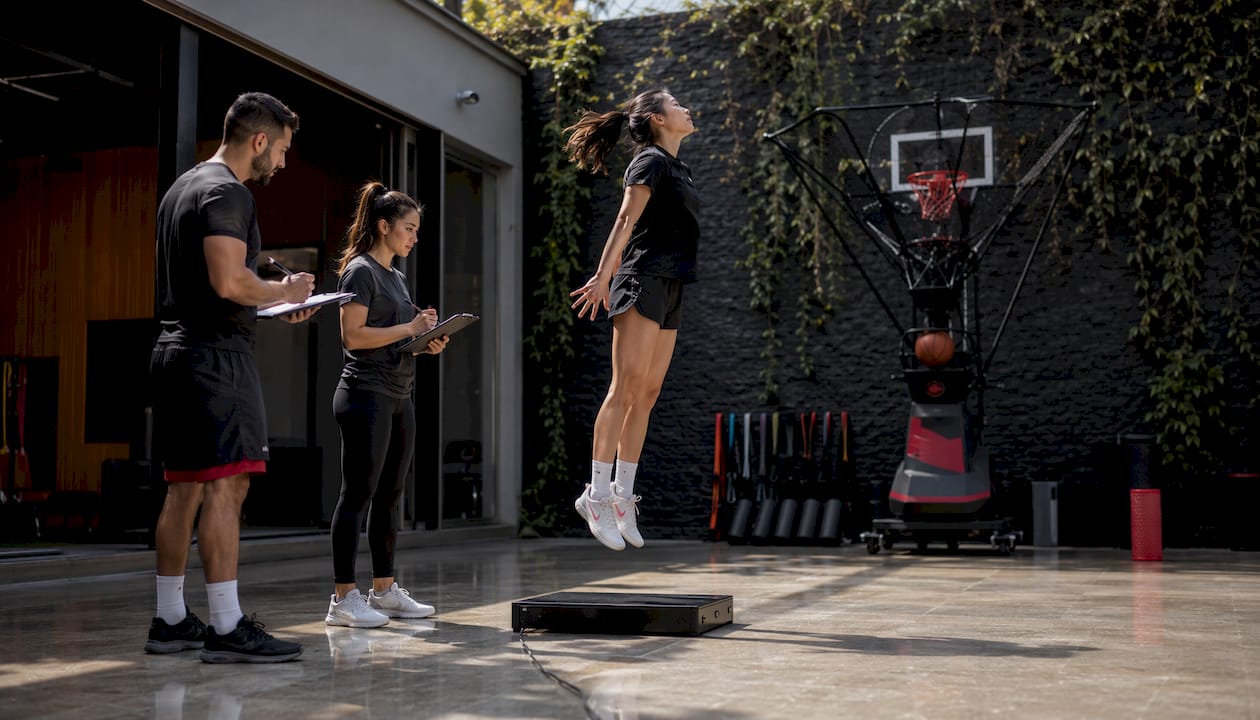
Shooting-machine technology like Dr. Dish is common in basketball-specific facilities and provides high-volume, repeatable shooting drills with objective shot counts. When evaluating private studios, ask specifically whether they have this equipment or a comparable system if shooting volume is a priority.
Pro Tip: Request a sample session plan from any private studio before signing. Coach-to-athlete ratio and written corrective cueing protocols are the operational behaviors that correlate most strongly with measurable skill gains — a sample plan reveals both.
Coach-marketplace and provider networks (national reach)
Beyond Athletes Untapped, provider marketplaces and coach networks let athletes connect with vetted coaches for 1-on-1 or small-group sessions and typically include pre/post assessments. The geographic flexibility is the main advantage: if you’re outside Northern Virginia or traveling for a season, you can find a credentialed coach in most metro areas. The tradeoff is that equipment access varies entirely by coach.
How do you choose between LST and its alternatives?
Start with your top two priorities. If injury management and PT access are both on the list, a hospital-affiliated program or integrated private studio is the right call regardless of price. If shooting volume is the primary goal, a facility with Dr. Dish or a comparable machine is non-negotiable. If documented metrics for a college recruiting profile matter, any program without pre/post assessments is off the table.
Questions to ask on a tour or call
- What certifications do your coaches hold? (Look for CSCS, NSCA-CPT, or physical therapy licensure)
- What is your coach-to-athlete ratio in group sessions?
- Can I see a sample baseline testing report from a current program?
- Do you offer a trial session, and what is your refund or cancellation policy?
- How often do athletes receive formal reassessments, and what metrics do you track?
- Is physical therapy available on-site or through a formal partner referral?
Red flags to watch for
- No objective progress metrics or testing at program start
- Vague or unverifiable staff credentials (“experienced coaches” with no certifications listed)
- Coach-to-athlete ratios above 1:8 in sessions marketed as personalized training
- No physical therapy integration when the athlete has an injury history
- Contracts with no trial period and no clear refund terms
How to compare pricing
Per-session pricing looks simple but obscures real cost. A package of 10 sessions at $80 each costs $800 — but if those are 90-minute group sessions with 10 athletes, the coached attention per athlete is minimal. Compare:
- Per-session rate vs. what’s included (duration, group size, equipment access)
- Package pricing vs. whether unused sessions roll over or expire
- Membership models vs. how many sessions per month are realistic given your schedule
The NSCA’s guidance on small-group training is clear: small groups of athletes per coach allow individualized corrective cueing, while larger groups shift toward general conditioning. That ratio is the single most useful number to extract from any sales conversation.
Why credentialed, multidisciplinary teams produce better results
The evidence for pairing CSCS coaches with physical therapists isn’t complicated. NSCA-recommended facilities prioritize staff who collaborate directly with health professionals so training adapts to an athlete’s physiology rather than following a fixed curriculum. When a 15-year-old’s movement screen flags a hip mobility deficit, a credentialed team catches it before it becomes a stress fracture. A general basketball gym typically does not.
Inova Sports Performance demonstrates this in practice: the program’s access to orthopedic surgeons and physical therapists means that a training progression can be modified in real time based on medical input, not just coach intuition. That’s a structural advantage for athletes with any injury history or those pushing into high training volumes.
Objective testing is the other half of the equation. Programs that track speed, vertical jump, rate of force development, and movement screens give athletes something concrete to work toward. Knowing your countermovement jump improved from 24 inches to 28 inches over 12 weeks is motivating in a way that “you’re getting better” is not. For sport performance testing, the metrics that matter most are the ones tied to your sport’s actual demands.
Pro Tip: Ask any program for a written baseline report and a schedule of periodic reassessments tied to training phases. If they can’t produce a sample, that’s your answer about how seriously they track progress.
Injury prevention is equally tied to programming quality. Flexibility and mobility work integrated into training sessions, rather than treated as an afterthought, is a marker of programs that think about long-term athlete development. The injury prevention habits that separate durable athletes from those who plateau or break down are almost always built into the program structure from day one.
Key Takeaways
The strongest alternative to Loudoun Sports Training is the one that matches your top two priorities — credentials and PT access for injury-managed athletes, objective testing for college-bound players, and equipment access for shooting-focused development.
| Point | Details |
|---|---|
| Match the program to your goal | College-bound athletes need documented metrics; injury-managed athletes need PT integration; shooters need machine access. |
| Credentials are verifiable | Ask for CSCS certification and PT licensure by name — reputable programs list staff credentials without hesitation. |
| Coach-to-athlete ratio matters | Groups of 4–8 per coach allow real corrective cueing; larger groups shift to general conditioning. |
| Objective testing drives progress | Programs with pre/post assessments give athletes measurable proof of improvement, not just coach feedback. |
| Bodiesbymahmood as an alternative | Bodiesbymahmood offers individualized performance training, baseline testing, and CSCS-informed programming for athletes at all levels. |
What most athletes get wrong when picking a training program
The conventional wisdom says to pick the facility with the best equipment list. That’s the wrong filter. Equipment is table stakes — most serious programs have Vertimax, shooting machines, or turf. The real differentiator is what happens between the equipment and the athlete: who’s watching, what they’re measuring, and whether they adjust the plan when something isn’t working.
Parents especially fall into the trap of equating a long equipment list with a high-quality program. A facility with Dr. Dish and Vertimax but a 1:12 coach-to-athlete ratio in “personalized” sessions is not delivering personalized training. It’s delivering supervised reps, which is a different thing entirely.
The other underrated factor is continuity. Athletes who work with the same coach across multiple training blocks, with reassessments at each transition, develop faster than those who rotate through different coaches in a marketplace model. The coach who knows your movement patterns from six months ago can spot regression before it becomes injury. That institutional knowledge is worth paying for, and it’s almost impossible to replicate in a pay-as-you-go structure.
The programs worth your time are the ones that can show you a testing report from a current athlete, name the specific assessments they run, and tell you exactly what triggers a program modification. If a program can’t answer those three questions in a first conversation, move on.
Bodiesbymahmood: a direct alternative for athletes who want individualized training
If you’ve read this far and what you actually want is a program that combines individualized performance training, baseline testing, and coaching grounded in real sports experience, Bodiesbymahmood is worth a direct look.

Bodiesbymahmood is a sports-specific training facility in Orlando with extensive experience working with athletes from amateur to professional levels. The training model maps directly to what this article recommends: individualized plans built from a baseline assessment, CSCS-informed programming, and a private-gym atmosphere that means your session isn’t competing with 15 other athletes for a coach’s attention. The facility covers the same ground as LST’s core services — skills development, jump training, strength and conditioning — but with the added layer of individualized personal training programs that adapt to each athlete’s physiology and goals.
For athletes who want to track their own progress between sessions, the fitness tracking practices the facility recommends give you a framework for measuring what’s actually changing. The approach to peak power output used in programming reflects current sports science, not a fixed curriculum. To get started, book an initial assessment through the personal training page — that first session establishes your baseline and maps the training plan to your specific goals.
Sources and further reading
The sources below back the claims in this article and are worth reviewing directly when vetting any program.
| Source | What it covers |
|---|---|
| Inova Sports Performance (Healthy Baller) | Hospital-affiliated performance training in Northern Virginia; 1-on-1, semi-private, and team formats with medical staff access |
| NSCA (National Strength and Conditioning Association) | CSCS credential standards, small-group training guidance, and evidence-based programming principles |
| Norton Sports Performance — SPORTready | Youth program model with pre/post assessments, skill-grouped sessions, and multidisciplinary staff |
| Loudoun Sports Training — Services | LST’s full service list including ELTP, Vertimax, Dr. Dish, and group skills formats |
| Athletes Untapped — Loudoun County | Coach marketplace for strength and speed training in Loudoun County, VA |
| Inova (organizational overview) | Background on Inova’s integrated health and sports medicine infrastructure |
When you contact any program, request the same three items from each: a sample baseline testing report, a list of staff credentials with certifications, and a sample session plan from a current program block. Any provider that hesitates on all three is telling you something important about how they actually operate.