


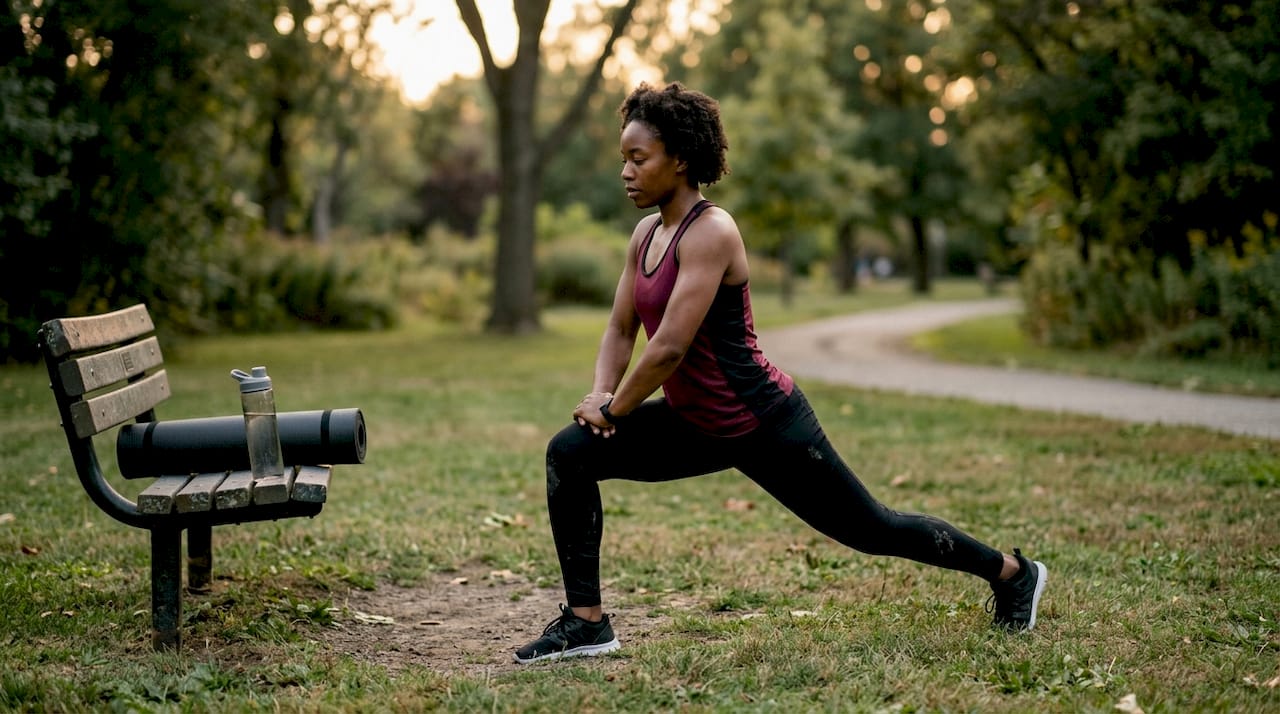
Flexibility is defined as a trainable physical fitness component that directly reduces injury risk by improving soft tissue extensibility and neuromuscular control. The role of flexibility in injury prevention is well established: research shows that a 1 cm decrease in joint flexibility increases injury risk by 6%, and athletes with a prior injury face a 6.4x higher recurrence risk without adequate rehabilitation of flexibility and strength. The American College of Sports Medicine (ACSM) recognizes flexibility as one of the five core components of physical fitness. Yet most athletes still treat stretching as an afterthought rather than a structured training priority.
How does flexibility training contribute to preventing injuries?
Flexible muscles and tendons absorb force more effectively during high-load movements. When soft tissue cannot lengthen under stress, it tears. That is the mechanical reality behind most muscle strains and ligament sprains in sport.
Flexibility also has a significant neural component. Neural control modulation allows muscles to lengthen without triggering protective reflex contractions. Without this neural tolerance, a muscle may resist lengthening and snap under sudden load, even if it appears structurally healthy. Consistency in training builds this tolerance over time, often more than the specific method used.

The link between decreased flexibility and injury incidence is well documented. Athletes with restricted hip flexor and hamstring flexibility show higher rates of lower extremity injuries across running, soccer, and basketball. The mechanism is straightforward: restricted tissue forces compensatory movement patterns, which overload adjacent joints and structures.
One important nuance: stretching alone does not prevent injuries. Systematic reviews caution against a stretching-only prevention mindset. Flexibility training works best when combined with strength, coordination, and neuromuscular control work.
- Flexible soft tissue absorbs impact forces that would otherwise cause micro-tears
- Neural regulation controls how far a muscle tolerates lengthening before contracting defensively
- Restricted flexibility creates compensatory movement patterns that overload joints
- Stretching alone produces limited chronic injury prevention benefit without integrated training
Pro Tip: Track your flexibility deficits by sport position, not just by muscle group. A pitcher needs shoulder external rotation; a sprinter needs hip flexor length. Targeted testing reveals the gaps that matter most.
What is the difference between flexibility and range of motion?
Flexibility and range of motion (ROM) are not the same thing. Confusing them leads to ineffective training prescriptions and, in some cases, injury.
Experts define flexibility as soft tissue extensibility combined with neural control. ROM is broader. It includes modifiable factors like flexibility and neural regulation, but also non-modifiable factors like bone structure and joint architecture. You cannot stretch your way past a bony block, and attempting to do so creates joint damage rather than mobility.
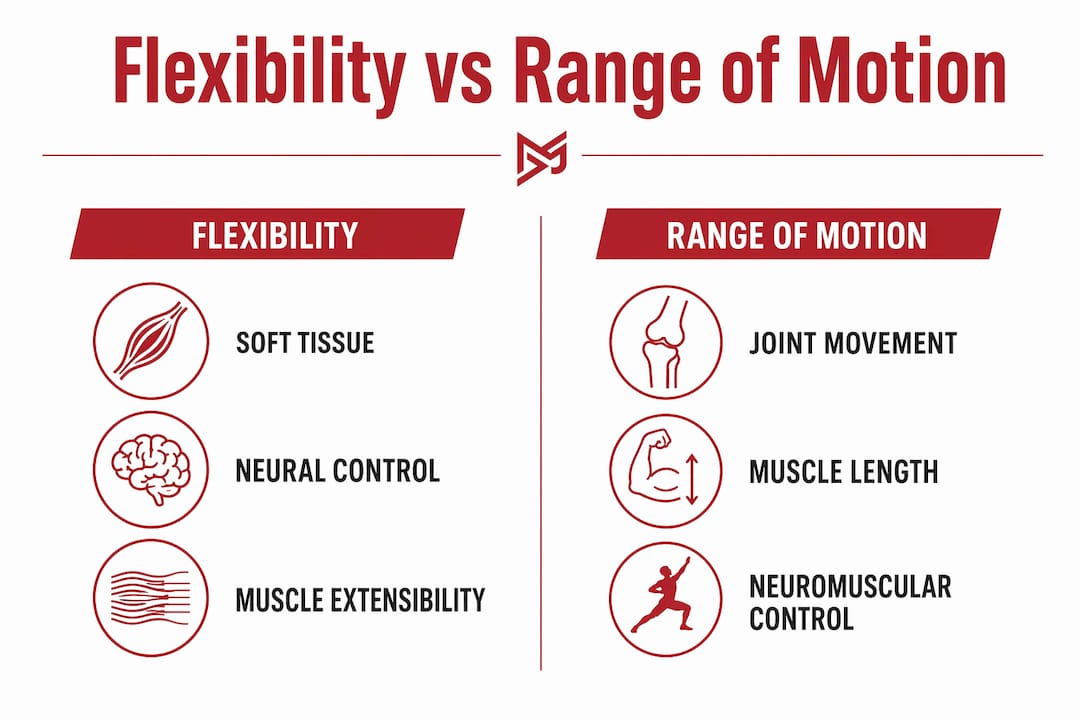
| Factor | Flexibility | Range of Motion |
|---|---|---|
| Definition | Soft tissue extensibility + neural control | Total joint movement capacity |
| Modifiable? | Yes, through training | Partially (soft tissue yes, bone structure no) |
| Training method | Stretching, strength, neuromuscular work | Flexibility training + joint mobilization |
| Injury risk if excessive | Moderate (if stability is lacking) | High (if bony limits are forced) |
| Assessment tool | Sit-and-reach, goniometry | Goniometry, clinical ROM testing |
This distinction matters for athletes because evaluating a “flexibility deficit” requires knowing whether the restriction comes from soft tissue or from joint structure. A tight hamstring responds to stretching and strength training through full ROM. A structural hip impingement does not. Treating one like the other wastes training time and risks harm.
Neuromuscular control also determines how safely an athlete uses available ROM. A gymnast may have extreme hip ROM but lack the stability to control it at end range. That combination raises injury risk rather than reducing it. Adequate ROM acts as a buffer during movement errors, but only when paired with the stability to manage it.
What are the most effective flexibility training strategies in 2026?
The strongest evidence now points to multi-modal programs, not isolated stretching routines. Exercise-based strategies combining dynamic stretching, neuromuscular warm-ups, and progressive resistance loading produce the most consistent reductions in injury risk across both youth and adult athletes.
Here are the four training approaches with the strongest current support:
-
Dynamic stretching and neuromuscular warm-ups. These replace static holds before activity. Dynamic warm-ups improve joint mobility, balance, and vertical jump performance while reducing injury incidence. Leg swings, hip circles, and walking lunges prepare tissue and neural pathways simultaneously.
-
Strength training through full range of motion. This is the most underused flexibility tool in sport. Meta-analyses confirm that full ROM strength training produces ROM gains comparable to static stretching while also building force production and joint stability. A deep squat or a Romanian deadlift trains flexibility and strength at the same time.
-
Eccentric and loaded stretching. Eccentric training, where a muscle lengthens under load, functions as a form of flexibility training. The Nordic hamstring curl is the clearest example. It increases hamstring length and reduces strain injury rates in soccer and sprinting. Loaded stretching blurs the line between stretching and strength work in a productive way.
-
Integrated injury prevention programs. Programs that combine flexibility, strength, power, and coordination work outperform stretching-only approaches. The benefits of flexibility in sports are fully realized only within these multi-modal frameworks, not in isolation.
Foam rolling deserves a mention as an adjunct method. Evidence shows foam rolling produces ROM gains similar to stretching over time. It works best as a warm-up tool or recovery aid, not as a primary flexibility training method.
Pro Tip: Replace your pre-workout static stretch routine with 8–10 minutes of dynamic movement prep. You will improve flexibility, activate the nervous system, and reduce injury risk without the performance-dulling effects of prolonged static holds before training.
How can athletes integrate flexibility training safely and effectively?
The goal is adequate functional flexibility, not maximum flexibility. Maximizing flexibility without stability can increase injury risk rather than reduce it. Every flexibility gain needs a corresponding stability adaptation to be useful and safe.
Balancing flexibility and stability
Hypermobile athletes, particularly in gymnastics, swimming, and dance, often need more stability work than flexibility work. Restricted athletes in power sports like football and sprinting typically need more flexibility work. Your sport, position, and injury history determine the right balance. Sport performance testing can identify where your specific deficits lie before you build a program.
Building a practical routine
A well-designed session for most athletes looks like this:
- Warm-up (8–10 minutes): Dynamic stretching, leg swings, hip openers, and movement-specific drills
- Main training block: Strength training through full ROM, including compound movements like squats, deadlifts, and lunges
- Accessory work: Eccentric exercises targeting high-risk areas (hamstrings, hip flexors, rotator cuff)
- Cool-down (5–10 minutes): Static stretching held for 30–60 seconds per muscle group, after training when tissue is warm
Common pitfalls to avoid
- Overstretching cold tissue before training, which reduces force output and risks micro-tears
- Ignoring neuromuscular control when gaining new ROM, which creates unstable end-range positions
- Applying the same flexibility program to every athlete regardless of sport or position
- Skipping progressive loading and jumping straight to extreme ROM work
Young athletes benefit from learning these principles early. The role of flexibility training for young athletes is especially significant because movement patterns formed in youth carry into adult sport. Building functional flexibility alongside strength from the start reduces cumulative injury risk across an entire career.
Key Takeaways
Flexibility reduces injury risk only when trained alongside strength and neuromuscular control, making integrated multi-modal programs the most effective approach for athletes at every level.
| Point | Details |
|---|---|
| Flexibility reduces injury risk | A 1 cm loss in joint flexibility raises injury risk by 6%, making it a measurable training target. |
| Neural control matters | Flexibility includes neural regulation that prevents protective reflex contractions during rapid movement. |
| ROM and flexibility differ | ROM includes non-modifiable bone structure; flexibility training only addresses the soft tissue and neural components. |
| Full ROM strength training works | Strength training through full range of motion builds flexibility and stability simultaneously, matching static stretching gains. |
| Integrated programs outperform stretching | Multi-modal programs combining dynamic warm-ups, strength, and eccentric work produce the strongest injury prevention results. |
Flexibility training: what 25 years of coaching has taught me
Most athletes I work with at Bodiesbymahmood come in thinking flexibility means touching your toes. That mental model leads them straight into routines that either do nothing or actively make things worse.
The biggest mistake I see is chasing maximum flexibility without building the stability to use it. A wide-open hip joint with no muscular control around it is not an asset. It is a liability waiting to express itself at the worst possible moment, usually mid-sprint or mid-cut. Adequate functional flexibility is the target, not the splits.
The second thing I have learned is that consistency beats method. Athletes who stretch moderately three to four times per week for months outperform athletes who do aggressive flexibility sessions twice a week. Neural adaptation to muscle length takes time. You cannot rush it, and you cannot cram it.
What actually works is treating flexibility as part of every session, not as a separate block. Full ROM squats, Romanian deadlifts, and Nordic curls build flexibility while building strength. That is a far better return on training time than 20 minutes of static holds that most athletes skip anyway.
The role of flexibility in daily fitness is just as real as in sport. Desk workers with restricted hip flexors and thoracic spines are just as vulnerable to injury as athletes, just in different contexts. The principles are the same: train the tissue, train the nervous system, and build stability alongside mobility.
— Mahmood
Bodiesbymahmood: training that builds flexible, resilient athletes
At Bodiesbymahmood, every training plan integrates flexibility, strength, and neuromuscular control from day one. The facility’s trainers bring over 25 years of experience working with athletes from amateur to professional levels in Orlando.
Whether you are recovering from a prior injury, preparing for a competitive season, or building a long-term fitness base, the personal training programs at Bodiesbymahmood are built around your specific movement profile, sport demands, and injury history. No generic stretching routines. No one-size-fits-all plans. Every session is designed to make you more durable, more mobile, and more capable. View the full range of training services to find the right fit for your goals.
FAQ
Does flexibility actually reduce injury risk?
Yes. Research shows a 1 cm decrease in joint flexibility increases injury risk by 6%, and athletes with prior injuries face a 6.4x higher recurrence risk without adequate flexibility and strength rehabilitation.
Is static stretching enough to prevent injuries?
No. Systematic reviews confirm that static stretching alone has limited chronic effect on injury prevention. Integrated programs combining strength, dynamic warm-ups, and neuromuscular training produce significantly better results.
What is the best time to stretch for injury prevention?
Dynamic stretching belongs before training to prepare tissue and activate the nervous system. Static stretching is most effective after training, when muscles are warm and more receptive to length changes.
How does flexibility training benefit young athletes?
Flexibility training in young athletes builds movement patterns and tissue resilience that reduce cumulative injury risk across an entire career. Combined with strength training, it supports healthy joint development and long-term athletic performance.
Can you have too much flexibility?
Yes. Excessive uncontrolled ROM without adequate joint stability raises injury risk. The goal is functional flexibility, meaning enough range to perform sport movements safely, paired with the strength and control to manage that range under load.