


Isometric training is defined as a method of muscle contraction where the muscle generates force without changing length or moving the joint. For athletes, this makes it one of the most targeted tools available for building tendon stiffness, improving maximum voluntary contraction (MVC), and increasing muscle cross-sectional area (CSA). Unlike dynamic lifting, isometric exercises for athletes create force at a fixed joint angle, which produces unique structural and neural adaptations that standard resistance training cannot fully replicate. Bodiesbymahmood has integrated isometric protocols into athlete programs for over 25 years, and the results consistently support what the science shows.
What is isometric training in sports?
Isometric training in sports refers to any exercise where an athlete contracts a muscle group against resistance without joint movement. The wall sit, the split squat hold, the plank, and the mid-thigh pull are all isometric exercises. Each one demands that the muscle produce force while staying at a fixed length. That fixed-length contraction is what separates isometric strength training techniques from concentric or eccentric movements.
Two main types of isometric contractions exist. Overcoming isometrics involve pushing or pulling against an immovable object with maximal intent. Yielding isometrics involve holding a position against gravity or a load, like a split squat hold at 90 degrees. Both types produce strength and hypertrophy adaptations, but they do so through different neuromuscular pathways.
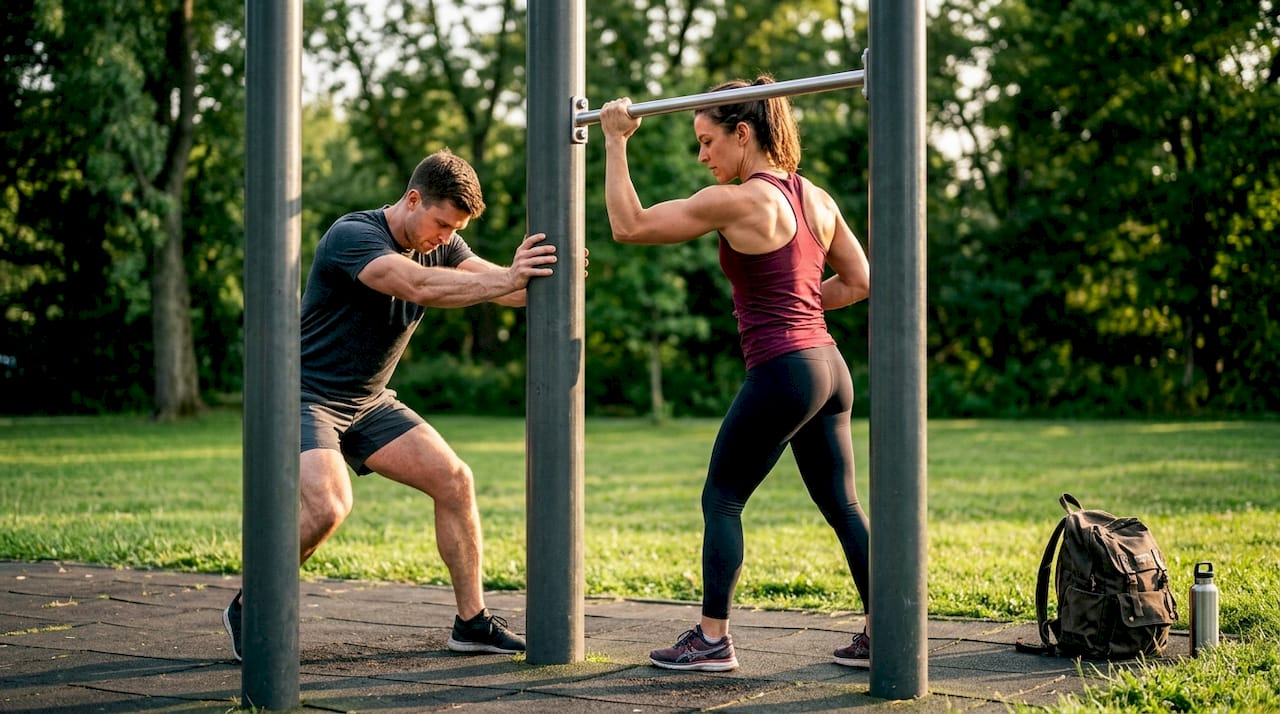
Neural intent is more important than external load for driving peak force and hypertrophic adaptations. That means an athlete pushing maximally against a fixed bar produces a stronger training stimulus than one holding a moderate load passively. The muscle does not know the bar is not moving. It only knows how hard you are trying.
Eccentric quasi-isometrics (EQIs) add a third dimension. The athlete slowly lowers into a position and then holds it until failure. EQIs combine the benefits of eccentric loading with sustained isometric tension, making them especially useful for tendon conditioning and end-range stability.
- Overcoming isometrics: maximal push or pull against a fixed object; best for peak force and rate of force development
- Yielding isometrics: holding a loaded position; best for tendon conditioning and postural stability
- Eccentric quasi-isometrics (EQIs): slow descent into a hold; best for end-range strength and tendon resilience
Pro Tip: During overcoming isometrics, treat the bar or wall as if you are trying to break it. The intent to produce maximal force, not the actual movement, is what drives the neural adaptation.
How effective is isometric training for strength, hypertrophy, and tendon health?
The evidence for isometric training is strong across three areas: muscle size, tendon adaptation, and performance enhancement. Muscle CSA increases range from 5.4% to 23% across consistent isometric protocols lasting 6 to 14 weeks. That range is wide because outcomes depend heavily on intensity, hold duration, and training intent. Athletes who train at high percentages of MVC with maximal intent land at the upper end of that range.
Tendon adaptation is where isometrics genuinely outperform dynamic training. Isometric tendon loading at 3 or more seconds and 70–90% MVC increases tendon stiffness by 17–36% after 12 weeks. Stiffer tendons transfer force more efficiently from muscle to bone, which directly improves sprint acceleration, jump height, and change-of-direction speed. Dynamic training produces tendon adaptations, but not at the same magnitude or rate.
“Isometrics are the current standard for tendon rehabilitation because they allow for controlled force application with minimal mechanical stress. That same property makes them ideal for healthy athletes who want to build tendon resilience without accumulating excessive fatigue.”
Performance benefits extend beyond structure. 3 to 4 sets of 2-minute isometric holds produce measurable vertical jump improvements and blood pressure reductions. The jump improvement comes from post-activation performance enhancement (PAPE), where the nervous system is primed by a heavy isometric contraction before an explosive effort. Coaches use this effect in warm-up protocols before sprint or jump sessions.
The key limitation of isometric training is joint-angle specificity. Strength gains are most pronounced near the trained joint angle, with limited transfer to other positions. An athlete who only trains the squat hold at 90 degrees will not automatically get stronger at 60 or 120 degrees. This means programming must include multiple angles or be deliberately matched to the sport’s most critical positions.
| Outcome | Isometric result | Key condition |
|---|---|---|
| Muscle CSA | 5.4%–23% increase | 6–14 weeks, high MVC intent |
| Tendon stiffness | 17%–36% increase | 3+ second holds at 70–90% MVC |
| Vertical jump | Significant improvement | PAPE protocol, 3–4 sets |
| Strength transfer | Joint-angle specific | Requires multi-angle programming |
What programming variables produce the best results for athletes?
Training outcomes depend heavily on duration, intensity, and intent. Changing any one of these variables shifts the adaptation. A 3-second hold at 90% MVC builds peak force. A 45-second hold at 60% MVC builds tendon conditioning and local muscular endurance. Athletes and coaches need to match the variable to the goal, not just pick a hold time arbitrarily.
Intensity and hold duration
For peak strength and hypertrophy, use 80–100% MVC with holds of 3–6 seconds per rep, repeated for 4–6 sets. For tendon health and rehabilitation, use 70–90% MVC with holds of 30–45 seconds, 3–4 sets, performed 4–5 days per week. For PAPE before explosive work, use a single 3–5 second maximal hold 3–5 minutes before the sprint or jump effort.

Joint angle selection
Joint angle selection determines where the strength transfer lands. For sprinters, a hip flexor isometric at the drive phase angle (roughly 90 degrees of hip flexion) targets the exact position that limits acceleration. For jumpers, a calf raise hold at the ankle’s push-off angle reinforces the tendon stiffness needed for elastic energy return. Match the angle to the sport’s critical moment.
Combining isometrics with dynamic training
Isometric training should complement, not replace, dynamic training because it lacks direct transfer to high-velocity sport tasks. The best programs use isometrics to build the structural foundation, then express that foundation through dynamic and sport-specific work. A typical weekly structure places isometric work on lower-intensity days or as a primer before explosive sessions.
Pro Tip: Pair a 5-second maximal isometric hold in the split squat position with your plyometric warm-up. The neural priming effect from the isometric contraction can increase jump height in the session that follows.
How is isometric training applied across different sports?
Sport-specific application is where isometric training moves from theory to results. The exercises and protocols differ by sport, but the underlying logic is the same: identify the critical joint positions and load them isometrically to build strength and resilience exactly where the sport demands it.
-
Soccer and rugby (hamstring injury prevention). Nordic hamstring and split squat isometric protocols reduce hamstring injury rates by 38% in professional soccer contexts. These holds target the hamstring at long muscle lengths, which is the position most vulnerable during high-speed running. Athletes perform split squat holds at 90 degrees for 30–45 seconds, 3–4 sets, 4 days per week during the preseason.
-
Basketball and volleyball (tendon health for jumping athletes). Calf raise isometric holds and split squat holds at 60 degrees of knee flexion build patellar and Achilles tendon stiffness. Stiffer tendons store and release elastic energy more efficiently, which directly improves jump height and reduces tendinopathy risk. Athletes performing these holds 4 days per week for 12 weeks see the most consistent tendon adaptation.
-
Golf and baseball (core stability for rotational sports). Rotational sports demand that the core transfers force from the lower body to the upper body without energy leakage. Isometric holds like the Pallof press hold, the Copenhagen plank, and the side bridge build the lateral and rotational stiffness that supports a powerful, repeatable swing or throw. These exercises are performed at 60–80% of perceived maximal effort for 20–30 seconds per side.
-
Sprinting and field sports (rate of force development). Overcoming isometrics at the hip and knee angles specific to the acceleration phase build the neural drive needed for explosive starts. A mid-thigh pull isometric held for 3–5 seconds at maximal intent primes the nervous system and builds peak force in the exact position that determines first-step quickness.
-
Rehabilitation and return-to-play. Isometrics are the standard starting point for tendon rehabilitation because they produce force with minimal mechanical stress on healing tissue. Athletes returning from patellar tendinopathy, Achilles issues, or hamstring strains use submaximal isometric holds to maintain muscle activation and begin tendon loading before progressing to dynamic work.
Key Takeaways
Isometric training builds muscle, stiffens tendons, and enhances explosive performance when programmed with the right intensity, duration, and joint angle for the sport.
| Point | Details |
|---|---|
| Muscle size gains are real | Consistent isometric protocols increase muscle CSA by 5.4%–23% over 6–14 weeks. |
| Tendon adaptation is the standout benefit | Holds at 70–90% MVC for 3+ seconds increase tendon stiffness by 17%–36% in 12 weeks. |
| Intent drives the adaptation | Maximal effort during holds produces peak force; submaximal sustained holds build tendon health. |
| Joint angle specificity matters | Program multiple angles or match the trained angle to the sport’s most critical position. |
| Isometrics complement dynamic training | Use isometrics to build the structural base, then express it through sport-specific dynamic work. |
What I have learned from 25 years of using isometrics with athletes
Most athletes who come to me have heard of isometric training, but almost none of them are doing it correctly. The most common mistake is treating a hold as passive. An athlete sits in a wall sit, watches the clock, and calls it done. That is not isometric training. That is just sitting. The contraction has to be active and intentional. You have to be trying to produce force, not just endure a position.
The second mistake I see constantly is using isometrics as a replacement for dynamic work. I have worked with athletes who read about tendon benefits and shifted their entire program to holds and planks. Their tendons got healthier, but their speed dropped. Isometrics lack transfer to high-velocity tasks. They build the foundation. Dynamic training builds the expression. You need both.
Isometric shaking during holds is one of the most useful pieces of feedback I use with athletes. When a hold starts to shake, that is not a sign to stop. It is a sign to pay attention. The shaking reveals the weak link in the movement pattern, the joint or muscle group that cannot sustain the required stability. That information tells me exactly where to focus the next training block.
The athletes who get the most from isometric training are the ones who treat it as a precision tool, not a filler exercise. They pick the right angle, apply maximal intent, and track their holds the same way they track their lifts. That level of attention is what separates a training session from a training stimulus.
— Mahmood
How Bodiesbymahmood builds isometric training into your program
At Bodiesbymahmood in Orlando, isometric training is not an add-on. It is a structured component of every athlete’s program, matched to their sport, their position on the field, and their current training phase. Whether you are a high school athlete building your first strength base or a professional managing tendon health through a long season, the protocols are built around your specific demands. Our personal training programs integrate isometric and dynamic training in the right sequence to produce real performance gains. For athletes preparing for the next level, our college-bound athlete programs include sport-specific isometric protocols designed to improve testing results and reduce injury risk before the recruiting process begins.
FAQ
What is isometric exercise in simple terms?
Isometric exercise is any movement where you contract a muscle without changing the joint angle. A wall sit, a plank, or pushing against an immovable object are all isometric exercises.
How long should isometric holds last for tendon health?
Holds of 30–45 seconds at 70–90% MVC, performed 3–4 sets, 4 to 5 days per week, produce the strongest tendon stiffness adaptations over a 12-week period.
Can isometric training replace weight training for athletes?
Isometric training cannot replace dynamic weight training. It builds muscle and tendon strength at specific joint angles but does not transfer to high-velocity sport tasks, which require dynamic loading.
How does isometric training prevent sports injuries?
Isometric protocols increase tendon stiffness and build strength at the joint angles most vulnerable during sport. In professional soccer, specific isometric programs reduced hamstring injury rates by 38%.
What does isometric shaking during a hold mean?
Shaking during an isometric hold signals neuromuscular fatigue and reveals weak points in an athlete’s stability. It is useful feedback for identifying which muscle groups need more targeted work.