



Sport performance testing is defined as a standardized, objective assessment of an athlete’s physical capabilities across strength, power, speed, agility, and aerobic capacity. It replaces guesswork with data, giving athletes and coaches a clear picture of where performance stands and where training must go. Whether you compete at the amateur or professional level, testing transforms how you train. Bodiesbymahmood has built its entire training model around this principle, using objective data to design programs that produce real, measurable results for athletes at every stage.
What is sport performance testing and what does it measure?
Sport performance testing is an objective, standardized battery of assessments covering the physical qualities that determine athletic success. The industry term for this process is “athletic performance assessment,” and both terms describe the same structured approach to measuring what your body can actually do. The core domains are maximal strength, explosive power, sprint speed, change-of-direction agility, and aerobic capacity. Each domain connects directly to sport demands, and each requires a different test protocol.
The most common tests in a standard battery include the vertical jump for lower-body power, 10-meter and 30-meter sprints for acceleration and top speed, the 5-10-5 shuttle drill for agility, and VO2 max testing for aerobic fitness. Maximal strength is typically measured through a one-rep max or estimated equivalent on compound lifts. These tests are not arbitrary. Each one isolates a specific physical quality that predicts performance in competition.

Sport specificity matters in test selection. A marathon runner gains more from VO2 max and lactate threshold testing than from a vertical jump protocol. A basketball player needs power and agility data more than endurance benchmarks. Choosing the wrong tests produces data that looks complete but tells you nothing useful about your sport.
| Test type | What it measures | Typical protocol |
|---|---|---|
| Vertical jump | Lower-body explosive power | Countermovement jump on force plate or mat |
| 10m/30m sprint | Acceleration and top-end speed | Timed sprint with electronic gates |
| 5-10-5 shuttle | Change-of-direction agility | Timed lateral shuttle over 20 yards |
| VO2 max | Aerobic capacity | Graded treadmill or cycle ergometer test |
| One-rep max | Maximal strength | Progressive loading on squat, bench, or deadlift |
How often should athletes undergo performance testing?
Athletes should schedule performance testing at least three times yearly: once for a baseline, once mid-season or mid-program, and once for pre-season readiness. The recommended monitoring interval is every 8–16 weeks. That window gives training adaptations time to develop while keeping the feedback loop tight enough to catch problems early.
Consistent scheduling matters because a single test tells you where you are. Repeated tests tell you whether your training is working. Without regular retesting, athletes often train hard without knowing if they are actually improving the qualities that matter for their sport.
Standardized conditions are non-negotiable for reliable data. Inconsistent testing conditions produce unreliable data that cannot support real decisions. Test at the same time of day, with the same hydration status, the same warm-up protocol, and similar fatigue levels each time. A result that changes because you were tired or dehydrated is not a performance change. It is noise.
- Test at baseline before starting any new training block
- Retest every 8–16 weeks to track adaptation
- Schedule a pre-season test to confirm readiness for competition demands
- Maintain identical conditions across every testing session
- Document all variables: time of day, sleep, nutrition, and recent training load
Pro Tip: Log your testing conditions alongside your results. If your sprint time improves by 0.2 seconds but you tested at 7:00 AM instead of your usual 10:00 AM, that context matters for interpreting the change.
Athletes preparing for collegiate competition can find testing scheduling guidance at Bodiesbymahmood, where programs are built around structured assessment timelines.
What benefits do athletes gain from performance testing results?
Performance testing converts subjective perception into objective data. Most athletes believe they know their strengths and weaknesses. Testing reveals that self-assessment is often wrong. An athlete who feels explosive may have a significant left-to-right power imbalance that only shows up on a force plate. An athlete who feels aerobically fit may have a VO2 max that sits below the threshold for their sport’s demands.
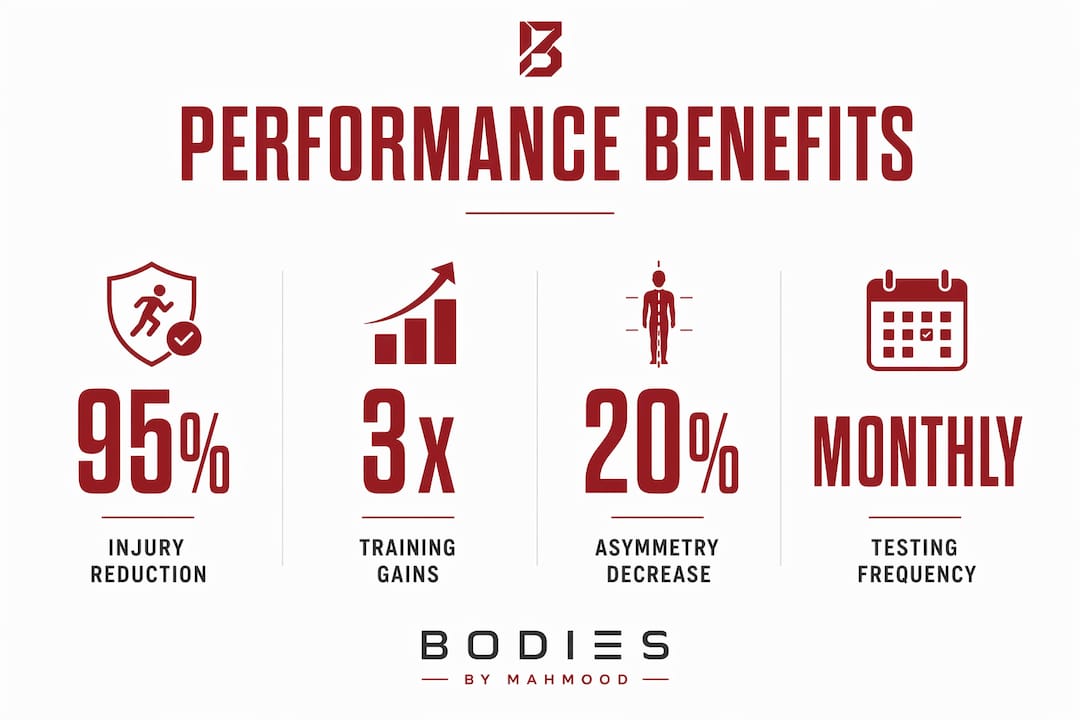
The most clinically significant benefit is asymmetry detection. Asymmetries are side-to-side differences in strength, power, or movement quality. Athletes rarely notice them without testing. Left uncorrected, these imbalances increase injury risk, particularly for the knee, hip, and ankle. Catching a 15% limb asymmetry in a single-leg jump test before it becomes a torn ACL is the kind of value that no amount of training by feel can replicate.
Testing also creates accountability. When an athlete sees their vertical jump increase from 24 inches to 28 inches over 12 weeks, the data confirms that the training program is working. That confirmation builds motivation and trust in the process. Without measurable benchmarks, progress feels abstract, and athletes are more likely to abandon programs that are actually producing results.
- Identifies physical strengths to build on in sport-specific training
- Reveals weaknesses and imbalances before they cause injury
- Creates objective benchmarks for tracking real progress
- Informs individualized program design based on actual data
- Replaces subjective training decisions with evidence-based adjustments
- Builds athlete confidence through measurable, documented improvement
Pro Tip: Ask your practitioner to break down your results by limb and side. A total score can look fine while hiding a significant asymmetry that puts you at risk.
The student athlete blog at Bodiesbymahmood covers how testing data has shaped training outcomes for athletes across multiple sports and age groups.
How is sport performance testing conducted and interpreted?
A professional performance assessment typically runs 60–90 minutes with a certified practitioner. The session combines multiple test types and ends with a personalized performance roadmap that connects your results to your training priorities. The structure is deliberate: tests are ordered to minimize fatigue effects, starting with power and speed before moving to strength and endurance.
Here is how a standard testing session unfolds:
- Intake and history review. The practitioner collects injury history, sport demands, and training background before any physical testing begins.
- Body composition assessment. Methods like DXA scanning or skinfold measurement establish lean mass and body fat percentages relevant to sport demands.
- Movement screening. A functional movement screen identifies mobility restrictions and compensatory patterns that affect how test results are interpreted.
- Physical performance battery. Sprint tests, jump tests, agility drills, and strength assessments are conducted in a standardized order.
- Aerobic capacity testing. VO2 max or a submaximal equivalent is measured using a cycle ergometer or treadmill protocol.
- Data interpretation and roadmap. Comprehensive interpretation combines test results with injury history and sport demands to produce specific training recommendations.
Consider a college soccer player who tests with a strong VO2 max but a 20% right-to-left single-leg jump asymmetry. The data tells the coach to maintain aerobic conditioning while prioritizing unilateral strength work on the weaker leg. Without testing, that asymmetry stays invisible, and the training program likely continues to develop the stronger side at the expense of the weaker one.
Objective testing replaces guesswork with precise program adjustments. The data does not just describe where you are. It tells you exactly where to direct your training effort for the greatest return.
Key Takeaways
Sport performance testing is the most direct path from subjective training to objective, measurable athletic progress.
| Point | Details |
|---|---|
| Define your baseline first | Test before starting any new program to establish a reference point for all future comparisons. |
| Retest every 8–16 weeks | Regular intervals reveal whether training is producing real adaptation or just effort. |
| Prioritize asymmetry detection | Side-to-side imbalances are the most common hidden injury risk that testing exposes. |
| Match tests to your sport | Select protocols that measure the physical qualities your sport actually demands. |
| Standardize testing conditions | Consistent time, hydration, and warm-up are required for results that mean anything. |
What I’ve learned from 25 years of watching athletes test
Most athletes walk into a testing session treating it like a tryout. They want to impress. They push too hard on the first sprint, skip the warm-up protocol, and then feel deflated when a number comes back lower than they expected. That mindset misses the entire point.
Testing is a diagnostic tool, not a report card. The number on the screen is not a judgment of your worth as an athlete. It is a starting coordinate. You cannot navigate without knowing where you are, and that is all a baseline test gives you: your current location on the map.
What I have seen consistently at Bodiesbymahmood is that athletes who embrace testing as a feedback mechanism improve faster than athletes who train by feel. The data removes the ego from the equation. When your single-leg jump shows a 15% asymmetry, there is no arguing with it. You address it, you retest, and you watch the gap close. That process builds a different kind of confidence than just logging hard workouts.
The athletes who use testing wisely also stop chasing the wrong things. A wide receiver who discovers his VO2 max is already elite but his 10-meter acceleration is average knows exactly where to spend his training time. Without that data, he might spend months on conditioning work that does nothing for his on-field performance.
Retest consistently, keep your conditions identical, and treat every result as information rather than judgment. That shift in mindset is where the real gains begin.
— Mahmood
Training at Bodiesbymahmood starts with your data
At Bodiesbymahmood, every personal training program begins with a performance assessment. With over 25 years of experience working with athletes from amateur to professional levels, the team uses your test results to build a program around your actual physical profile, not a generic template. Strength gaps, asymmetries, and sport-specific demands all shape the training plan from day one. The result is a program that addresses what your body actually needs, not what a standard protocol assumes. If you are ready to train with data behind every decision, learn more about how Bodiesbymahmood builds athlete-specific programs around objective results.
FAQ
What is sport performance testing?
Sport performance testing is a standardized, objective assessment of an athlete’s physical qualities including strength, power, speed, agility, and aerobic capacity. It produces measurable data used to guide individualized training and track progress over time.
How often should athletes get performance tested?
Athletes should test at least three times per year, with retesting every 8–16 weeks to monitor adaptation and adjust training programs based on current data.
What does a performance testing session include?
A typical session runs 60–90 minutes and covers body composition, movement screening, sprint and jump tests, agility drills, and aerobic capacity measurement, ending with a personalized performance roadmap.
Why is asymmetry detection important in athletic testing?
Asymmetries are side-to-side differences in strength or power that increase injury risk. Testing identifies these imbalances before they cause harm, allowing targeted corrective training.
Can performance testing help with injury prevention?
Yes. Identifying asymmetries and movement deficiencies through regular testing allows practitioners to address risk factors before they result in injury, making testing one of the most effective injury prevention tools available.