


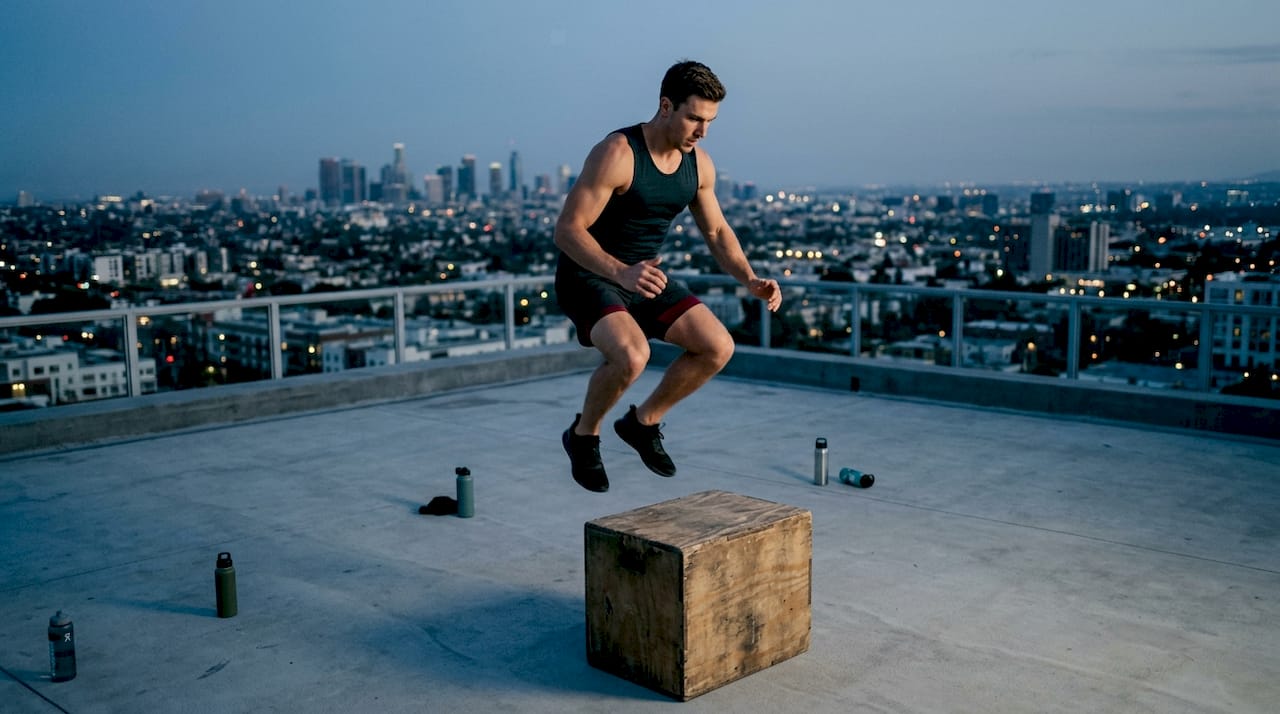
Jump training is defined as a structured method of plyometric exercise that improves explosive power by training the stretch-shortening cycle (SSC), the rapid eccentric-to-concentric muscle action that drives nearly every athletic movement. Understanding why jump training improves sport output means looking beyond jump height. A 2026 meta-analysis covering 36 studies and 921 female team sport athletes found significant gains in sprint speed, agility, and both vertical and horizontal jump performance. Those numbers tell a clear story: plyometric training reshapes how your neuromuscular system produces force, and that change shows up across multiple sport skills. Bodiesbymahmood has built its training philosophy around exactly this principle, applying over 25 years of sport-specific coaching to help athletes at every level unlock these adaptations.
Why jump training improves sport output: the physiology
The stretch-shortening cycle is the engine behind every explosive athletic action. When a muscle lengthens rapidly under load (the eccentric phase) and immediately contracts (the concentric phase), it stores and releases elastic energy like a compressed spring. Plyometric training enhances SSC efficiency, which means your muscles can produce more force in less time.
Three specific adaptations drive this improvement:
- Rate of force development (RFD): Jump training increases how quickly your muscles generate peak force. Higher RFD directly improves sprint acceleration and change-of-direction speed.
- Neural drive: Motor unit recruitment and firing frequency both increase with plyometric training. More motor units firing faster means greater explosive output per contraction.
- Leg stiffness and reactive strength: A 12-week plyometric program in youth soccer players produced significant gains in relative leg stiffness alongside sprint and broad jump improvements. Greater leg stiffness allows faster ground contact times, which is critical for sprinting and reactive movements.
These three adaptations work together. You are not just getting stronger. You are training your nervous system to apply that strength faster and more efficiently in sport-specific situations.
Pro Tip: Track reactive strength index (RSI) during your jump training blocks. RSI measures jump height divided by ground contact time and gives you a direct window into SSC efficiency gains that vertical jump height alone will miss.
Does jump training improve sports skills beyond jump height?
The short answer is yes, and the evidence is stronger than most athletes realize. Jump height is the most visible metric, but it is often not the most meaningful one for sport performance.
A systematic review of adult rugby players found consistent sprint and change-of-direction gains from plyometric training across seven studies involving 178 male players. Vertical jump height improvements, however, were inconsistent. That finding matters because it tells you that sprint acceleration and reactive agility are responding to the training stimulus even when the jump test does not move.
The table below summarizes key performance outcomes from recent research:
| Performance Measure | Evidence Strength | Key Finding |
|---|---|---|
| Vertical jump | Moderate | SMD = 0.67 in female team sport athletes |
| Horizontal jump | Moderate | SMD = 0.70 in female team sport athletes |
| Sprint speed | Strong | SMD = -0.85; consistent across rugby and soccer |
| Agility | Strong | SMD = -1.09 in female team sport athletes |
| Reactive strength | Strong | Consistent gains in rugby and youth soccer |
| Change of direction | Strong | Consistent gains in rugby players |

Sprint and agility improvements often reflect enhanced eccentric-to-concentric transition efficiency rather than raw jump height gains. This means athletes in field sports, court sports, and combat sports can expect real performance returns from jump training even if their vertical jump does not improve dramatically. The sport output gains are real. They just show up in different tests.
What programming factors determine jump training effectiveness?
Load selection is the most underappreciated variable in plyometric programming. Moderate external loads of 5–15% body weight optimize vertical jump performance by enhancing SSC mechanics and muscle force output. Low loads at or below 5% body weight favor sprint improvements instead. Higher loads impair both outcomes.
This means your load prescription should match your performance target. A basketball player prioritizing vertical jump needs a different load than a wide receiver prioritizing sprint acceleration. Both can use plyometric training, but the program must reflect the goal.
SSC type also shapes exercise selection:
- Slow SSC exercises (ground contact time above 250 milliseconds): squat jumps, broad jumps, standing long jumps. These build maximal force output and are well-suited to early training phases.
- Fast SSC exercises (ground contact time below 250 milliseconds): drop jumps, hurdle hops, sprint-specific bounds. These train reactive strength and are most specific to sprinting and agility demands.
Research on aquatic plyometrics found that land training outperforms aquatic methods for fast SSC tasks requiring short ground contact times. Aquatic training can match land training for slow SSC tasks. This distinction matters when athletes are managing injury risk or load tolerance.
Combining plyometric work with sprint and strength training produces the most complete neuromuscular development. Blending sprint and strength training with plyometrics covers both reactive SSC improvements and maximal force capacity. Neither element alone delivers the full range of sport output gains.
Pro Tip: Sequence your sessions so that plyometric work comes before heavy strength training in the same session. Performing jumps on a fresh nervous system maximizes power output and training quality.
How can athletes tailor jump training to their sport?
Personalizing jump training starts with identifying the dominant SSC demands of your sport. A volleyball player needs fast SSC vertical power. A soccer midfielder needs fast SSC horizontal and lateral reactivity. A baseball pitcher needs unilateral lower-body power and rotational force transfer. Each profile calls for a different exercise mix.
Follow this process to build a sport-specific jump training plan:
- Assess your sport’s movement demands. Identify whether your sport is dominated by vertical, horizontal, or lateral explosive actions, and whether ground contact times are fast or slow. Sport performance testing gives you objective data to anchor this assessment.
- Select exercises that match your SSC profile. Prioritize fast SSC drills for sports requiring rapid ground contacts. Use slow SSC exercises to build foundational force output in early training phases.
- Balance bilateral and unilateral work. Most sports involve single-leg actions. Include unilateral plyometrics like single-leg bounds and lateral hops alongside bilateral exercises to close the gap between training and competition movement patterns.
- Adjust load based on your primary goal. Use loads in the 5–15% body weight range for jump height. Stay at or below 5% body weight when sprint speed is the priority.
- Account for maturity stage. Research in youth soccer shows that pre-PHV athletes adapt through neuromuscular plasticity while post-PHV athletes gain more through morphological changes. Younger athletes respond well to higher volumes of lower-intensity plyometrics. Older athletes can handle heavier loads and more complex reactive drills.
- Monitor and adjust. Track RSI, sprint times, and agility scores across training blocks. If sprint speed is improving but jump height is stalling, that is a normal and acceptable outcome for many team sport athletes.
The goal is not to build a generic jumper. The goal is to build a more explosive version of the athlete your sport requires you to be.
Key Takeaways
Jump training improves sport output by enhancing SSC efficiency, neural drive, and reactive strength, producing measurable gains in sprinting, agility, and explosive power across sports and athlete levels.
| Point | Details |
|---|---|
| SSC efficiency drives gains | Plyometric training improves the eccentric-to-concentric transition that powers sprinting, jumping, and agility. |
| Sprint gains often exceed jump height gains | Rugby and soccer research shows consistent sprint and agility improvements even when vertical jump results are mixed. |
| Load determines the adaptation | Moderate loads (5–15% body weight) target jump height; low loads (≤5%) favor sprint speed improvements. |
| Exercise type must match SSC demands | Fast SSC drills build reactive strength; slow SSC drills build maximal force output for different sport contexts. |
| Maturity stage shapes the response | Pre-PHV athletes gain through neural plasticity; post-PHV athletes respond more to morphological adaptations from heavier loads. |
What 25 years of coaching jump training has taught me
Most athletes come to jump training wanting a bigger vertical. That is a reasonable goal, but it is also a narrow one. The athletes who get the most out of plyometric work are the ones who stop chasing a single number and start asking what their sport actually demands from their legs.
I have seen rugby players add meaningful sprint speed and change-of-direction ability through a well-structured plyometric block while their vertical jump barely moved. By the old metric, the program “didn’t work.” By every sport-relevant metric, it absolutely did. Vertical jump height is a proxy. Sprint acceleration and reactive agility are the real currency in most team sports.
The other mistake I see constantly is ignoring load. Athletes assume more intensity always means more adaptation. The research is clear that load-specific plyometric effects are real. Exceeding the optimal load range does not produce better results. It produces worse ones. Programming nuance is not optional. It is the difference between a training block that transfers to the field and one that just makes you tired.
At Bodiesbymahmood, we assess before we prescribe. Every athlete gets a performance profile before we design a jump training program. That profile tells us which SSC type to prioritize, what load range to use, and which sport output metrics to track. The college-bound athletes we work with especially benefit from this approach, because recruiters are watching sprint times and agility scores, not just vertical jump numbers.
— Mahmood
How Bodiesbymahmood builds jump training into your sport program
Athletes who want to turn plyometric science into real sport results need more than a program. They need a coach who understands how to match training to sport demands.
At Bodiesbymahmood in Orlando, every personal training program is built around your sport, your position, and your current performance profile. The coaching team integrates plyometric and strength training in the right sequence, at the right load, for the right SSC demands. Whether you are a high school athlete building a foundation or a professional looking to sharpen explosive output, the programming reflects what your sport actually requires. With over 25 years of experience in sport-specific training, Bodiesbymahmood delivers results backed by both research and real-world coaching practice.
FAQ
Why does jump training improve sprint speed?
Jump training improves sprint speed by increasing rate of force development and enhancing eccentric-to-concentric transition efficiency. These neural and mechanical adaptations reduce ground contact time and increase stride power, which are the two primary drivers of sprint acceleration.
Is vertical jump height the best measure of jump training success?
Vertical jump height is not always the best measure of training success. Research in rugby shows that sprint speed, change of direction, and reactive strength improve consistently from plyometric training even when vertical jump results are mixed.
How long does it take to see results from jump training?
A 12-week plyometric program in youth soccer players produced significant sprint and jump improvements, suggesting meaningful adaptations are measurable within three months of structured training.
What load should I use for jump training?
Load depends on your goal. Moderate loads of 5–15% body weight optimize vertical jump performance, while loads at or below 5% body weight produce greater sprint speed improvements.
Can young athletes benefit from jump training?
Yes. Research confirms that youth athletes across maturity stages benefit from plyometric training, with pre-PHV athletes gaining primarily through neuromuscular plasticity and post-PHV athletes responding more to morphological adaptations from progressive loading.