



A properly designed warm-up reliably reduces injury risk and improves short-term performance in young athletes — and the evidence behind that claim is stronger than most coaches realize. A meta-analysis of 15 clustered randomized controlled trials found that structured warm-up programs cut injury rates in children and adolescents by 36%. That single number should settle any debate about whether warm-up time is worth protecting on a practice schedule.
The core effects happen fast and in sequence:
- Muscle temperature rises, making fibers more elastic and less prone to tears
- Blood flow increases, delivering oxygen to working muscles before peak demand hits
- The nervous system activates, sharpening reaction time and coordination
- Sport-specific movement patterns get rehearsed, so the first real rep isn’t also the first time the body has done it
36% reduction in injury rates — the pooled result from 15 randomized controlled trials on structured warm-up programs in youth sports.
Table of Contents
- How do warm-ups lower injury risk and boost performance?
- What should a complete youth warm-up include?
- How should warm-ups change as athletes get older?
- Sample warm-up routines coaches and parents can use
- What mistakes do coaches and parents most often make?
- What does the research actually show?
- Key Takeaways
- The warm-up is the session, not the preamble
- Sources and further reading
How do warm-ups lower injury risk and boost performance?
The mechanism is not mysterious. When muscle temperature climbs, fibers stretch further before they fail. When blood vessels dilate gradually, the heart isn’t hit with a sudden demand spike. The American Heart Association specifically recommends gradual cardiovascular progression to reduce abrupt cardiac workload — a point that matters even for healthy kids.
Neuromuscular activation is where the real performance gains live. Balance drills, single-leg work, and controlled plyometrics teach the nervous system to fire muscles in the right sequence and at the right time. That translates directly to safer landings, better change-of-direction mechanics, and lower-limb protection during the unpredictable movements that define most youth sports. Neuromuscular warm-up protocols combining balance, agility, plyometrics, and strength show measurable improvements in agility, jump, and sprint metrics — not just injury numbers.
Performance gains from warm-up across studies range from 1% to 20% depending on how well the protocol matches the sport’s demands. For a youth athlete, even the low end of that range is meaningful over a season.
Signs a warm-up is working:
- Breathing rate increases noticeably but the athlete can still speak in short sentences
- Skin shows light perspiration within the first 5 minutes
- Movement quality improves from rep 1 to rep 5 of any drill
- Athletes report feeling “loose” and focused before the main session begins
What should a complete youth warm-up include?
The RAMP framework — Raise, Activate & Mobilize, Potentiate — gives coaches a clear structure that eliminates guesswork. Each phase builds on the last, and intensity climbs progressively so the body is genuinely ready when the real work starts.
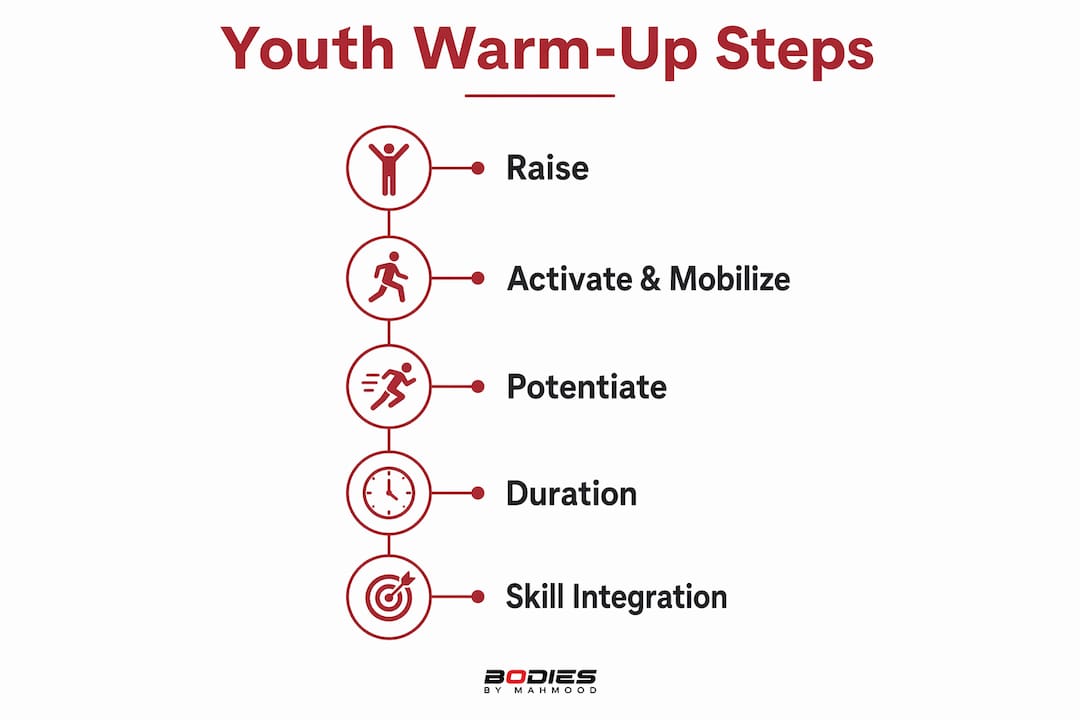
Raise (3–5 minutes) Light aerobic activity: jogging, skipping, lateral shuffles, or a tag-based game. The goal is simply to elevate core temperature and increase joint fluid viscosity. For younger kids, a structured game here doubles as engagement — they warm up without realizing it.
Activate & Mobilize (4–6 minutes) Dynamic mobility and muscle activation: leg swings, hip circles, inchworms, glute bridges, and single-leg balance holds. Dynamic stretching before activity is preferred over static holds because static stretching can acutely reduce muscle power output. Save the long static holds for the cool-down.
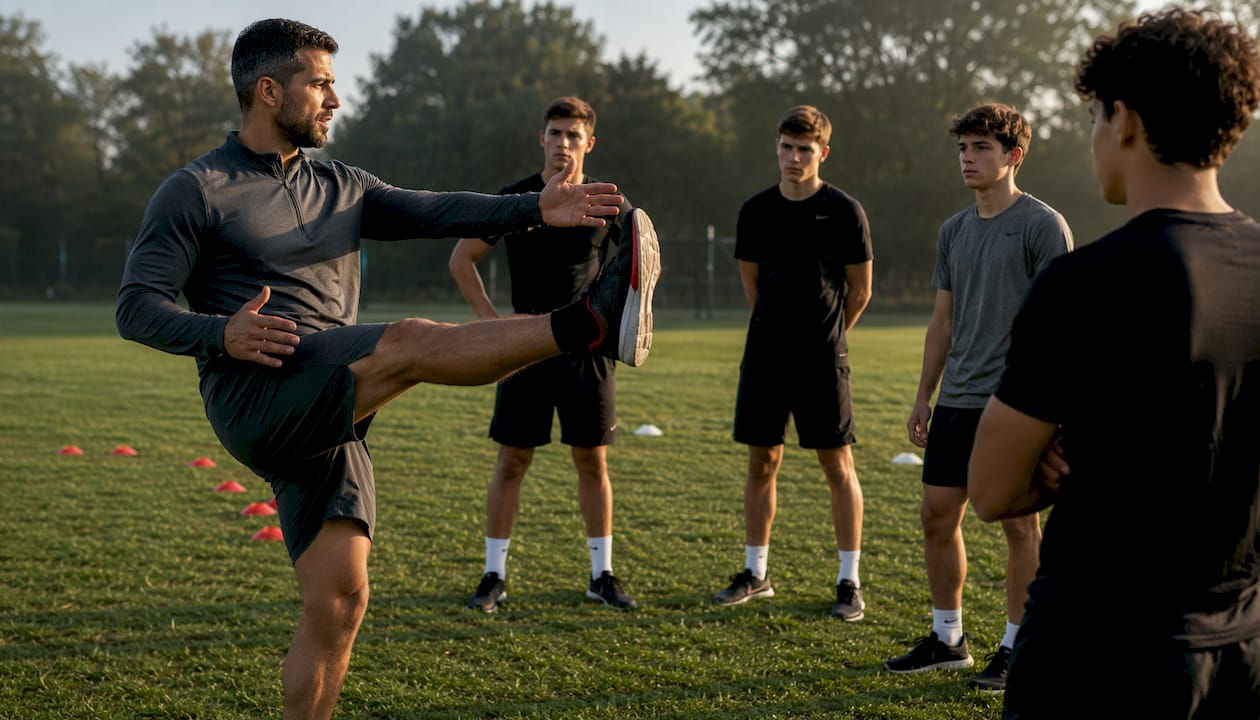
Potentiate (3–5 minutes) Sport-specific drills that replicate game demands: lateral cuts, acceleration bursts, jump-land sequences, or sport-specific footwork patterns. This phase primes the neuromuscular system for the exact movements athletes will perform. Bodyweight exercises work well here — no equipment needed, and the movement quality is easy to monitor.
Total recommended duration for most youth sessions is about the length of a typical warm-up. Neuromuscular-focused routines used as a primary injury-prevention tool may run longer.
Pro Tip: Embed a 2-minute skill game into the Raise phase. It raises temperature, builds coordination, and gets athletes mentally engaged before you’ve said a word about the main session.
How should warm-ups change as athletes get older?
Younger children and adolescents have genuinely different needs, and treating a 7-year-old the same as a 15-year-old is one of the most common mistakes in youth coaching. Maturity differences during adolescence — particularly the growth spurts that alter limb length, strength ratios, and coordination — mean warm-up content needs to adapt, not just scale up in duration.
| Age Group | Suggested Duration | Primary Focus |
|---|---|---|
| Under 8 (U8) | 5–8 minutes | Play-based movement, basic coordination, fun |
| Under 12 (U12) | 8–12 minutes | Dynamic mobility, balance, fundamental patterns |
| Under 15 (U15) | 10–15 minutes | Neuromuscular activation, sport-specific drills |
| 15 and older | 12–20 minutes | Full RAMP sequence, power priming, COD work |
U8 dos and don’ts:
- Do use animal walks (bear crawls, duck walks), tag games, and simple balance challenges
- Don’t prescribe formal sets and reps — keep it exploratory and movement-rich
- Do keep instructions short and demonstrate rather than explain
U12 dos and don’ts:
- Do introduce single-leg balance, lateral shuffles, and controlled landing practice
- Don’t skip the Activate phase — this age group is building the movement library they’ll rely on for years
- Do vary exercises across sessions to prevent boredom and build broader physical literacy
U15 and older:
- Do progress toward full neuromuscular sequences with plyometric elements
- Don’t ignore individual maturity differences — two 14-year-olds can be at very different developmental stages
- For athletes preparing for collegiate competition, sport-specific performance assessments can help calibrate warm-up intensity to actual readiness levels
Sample warm-up routines coaches and parents can use
Routine A: Quick 8–10 minute team warm-up
Best for: practice days with limited time, younger age groups
- Jog or skip (2 min) — easy pace, full field length and back
- Leg swings (1 min) — 10 forward/back each leg, holding a wall or partner for balance
- Inchworms (1 min) — walk hands out to plank, walk feet back, repeat x6
- Lateral shuffles (1 min) — 10 yards each direction, low athletic stance
- Glute bridges (1 min) — 2 sets of 10, slow and controlled
- Sport-specific acceleration (2–3 min) — 3–4 short sprints at 70–80% effort with full recovery between
Routine B: 15–20 minute neuromuscular injury-prevention routine
Best for: 2–3 sessions per week as a primary prevention tool, U12 and older
- Jog with directional changes (3 min) — add 90-degree cuts every 10 yards
- Hip circles and leg swings (2 min) — dynamic mobility for hips and hamstrings
- Single-leg balance (2 min) — 30 seconds each leg, eyes open then closed
- Monster walks (2 min) — lateral walks in a half-squat position, teaching hip control and glute activation; no band required for beginners
- Squat jumps with soft landing (2 min) — focus on landing mechanics: soft knees, hips back, quiet feet
- Lateral bounds (2 min) — single-leg push sideways, stick the landing, hold 2 seconds
- Sport-specific drill (3–5 min) — dribbling patterns, passing sequences, or position-specific footwork
Progression note: After 3–4 weeks, add a resistance band to monster walks and increase jump height on squat jumps. After 6–8 weeks, introduce single-leg landing variations. Jump training progressions can guide the plyometric phase as athletes advance.
Routine C: Individual pre-game activation (5–7 minutes)
Best for: athletes who arrive late, individual sports, or solo pre-game prep
- Light jog (2 min) — self-paced, enough to break a light sweat
- Dynamic leg swings and arm circles (1 min)
- Glute bridges or single-leg squats (1 min) — 8–10 reps each side
- 3–4 sport-specific accelerations (2 min) — short, sharp, at game speed
What mistakes do coaches and parents most often make?
The most common error is treating warm-up as optional time — something that happens if the team arrives early enough. The second most common is running a warm-up that is technically present but physiologically useless: five minutes of static stretching followed by an immediate sprint drill.
Common mistakes to avoid:
- Too short: Under 5 minutes rarely raises muscle temperature enough to matter
- Static stretching only: Long holds before activity can reduce power output; use dynamic movement instead
- Ignoring skill level: A drill that challenges a 15-year-old may overwhelm a 9-year-old and create anxiety rather than readiness
- Jumping straight to high intensity: Abrupt cardiovascular demand is exactly what a warm-up exists to prevent
- Poor supervision: Warm-up is when technique errors are easiest to spot and correct — coaches who check their phones during this phase miss the teaching window
Red flags to act on immediately:
- Dizziness or lightheadedness → stop, seat the athlete, assess
- Chest pain or tightness → stop all activity, follow emergency protocols
- Sharp, localized joint pain → do not push through; evaluate before continuing
Pro Tip: Run a 60-second movement quality check before the main session: watch each athlete do one squat, one lateral shuffle, and one single-leg balance hold. If something looks off, you know before the intensity climbs.
For flexibility and injury prevention context that goes beyond the warm-up itself, structured mobility work across the full training week compounds the protective effect.
What does the research actually show?
The evidence base for structured warm-ups in youth sports is solid, not just plausible. The 36% injury rate reduction from 15 clustered randomized controlled trials is the headline finding, but the performance data is equally compelling.
Neuromuscular warm-up protocols produced a change-of-direction effect size of g = 0.46 and a knee isokinetic strength effect size of g = 0.72 versus control conditions, according to a Frontiers systematic review and meta-analysis.
Those are meaningful numbers. An effect size above 0.5 is generally considered moderate to large in sports science, and the knee strength finding approaches large. Frequency and number of sets moderate the outcomes — which is why implementation frequency matters: 2–3 sessions per week is the recommended target for measurable COD and strength gains.
It’s worth noting that older randomized evidence is mixed at the individual study level. Three of five high-quality RCTs found significant injury reduction; two did not. The pooled data favor warm-ups, but that nuance is worth knowing — it means protocol quality matters. A poorly designed warm-up won’t deliver the same results as a structured neuromuscular sequence.
Evidence-backed program features to look for:
- Combines balance, plyometrics, strength, and agility in sequence (not just one element)
- Requires no extra equipment and fits within existing practice time
- Progresses in complexity over weeks, not just intensity
- Includes landing mechanics and single-leg control as core elements
- Can be delivered by a coach without specialized equipment (FIFA 11+ is the most widely studied example of this model)
Programs built on these principles — including the FIFA 11+ template and similar neuromuscular protocols — have the strongest track record. Coaching resources and warm-up protocol guidance can help coaches adapt these frameworks to their specific sport context.
Key Takeaways
A structured warm-up reduces youth sports injury rates significantly and produces measurable performance gains — making it a high-return segment in any practice plan.
| Point | Details |
|---|---|
| Injury reduction is real | A meta-analysis found structured warm-ups cut youth injury rates significantly. |
| Use the RAMP structure | Raise, Activate & Mobilize, and Potentiate phases build intensity progressively and safely. |
| Dynamic beats static pre-activity | Dynamic mobility before play preserves muscle power; save static holds for cool-down. |
| Age determines content | U8 needs play-based movement; U15+ can handle full neuromuscular sequences. |
| Frequency drives results | Run a neuromuscular routine 2–3 times per week for measurable strength and COD gains. |
The warm-up is the session, not the preamble
Most coaches treat the warm-up as the thing before the real work. After 25 years of working with athletes at every level, the coaches who get the best long-term results treat it the other way around: the warm-up is where movement habits are built, where technique gets corrected before fatigue sets in, and where young athletes learn what their bodies can do.
The biggest shift I’d encourage any coach or parent to make is this: stop thinking about warm-up as injury prevention and start thinking about it as skill practice that also prevents injury. When you frame it that way, you stop cutting it short when you’re running late. You stop letting kids jog a lap and call it done.
Embed a game into the Raise phase. Make the balance drills competitive. Let the sport-specific drills at the end feel like the preview of what’s coming. Athletes who enjoy the warm-up do it fully, every time — and that consistency is what actually moves the needle on both safety and performance.
If you want a structured program that builds these habits from day one, sport-specific personal training at Bodiesbymahmood is designed exactly for this. Or explore membership options for ongoing supervised training that keeps young athletes developing safely across the full season.

Sources and further reading
The findings in this article draw from peer-reviewed meta-analyses, systematic reviews, and guidance from major health organizations. The sources below are the highest-value references for coaches and parents who want to go deeper.
| Source | Type | Key Contribution |
|---|---|---|
| Myburgh, Pfeifer & Hecht, Strength & Conditioning Journal | Peer-reviewed review | RAMP framework, physical literacy framing, youth warm-up template |
| PMC meta-analysis — 15 RCTs | Meta-analysis | 36% injury rate reduction in children and adolescents |
| PubMed 35875288 — neuromuscular warm-up | Meta-analytic evidence | COD and strength improvements from neuromuscular protocols |
| Frontiers — neuromuscular meta-analysis | Systematic review | Effect sizes: COD g = 0.46, knee strength g = 0.72 |
| American Heart Association — warm-up guidance | Health organization | Cardiovascular safety and gradual heart rate progression |
| PubMed 16679062 — older RCT review | Systematic review | Mixed individual-study results; pooled data favor warm-ups |
Bodiesbymahmood resources for coaches and parents:
- Why bodyweight training suits young athletes — exercise selection for youth warm-up phases
- Flexibility and injury prevention for athletes — how structured mobility work compounds warm-up benefits
This article provides general educational information about warm-up practices in youth sports. It is not a substitute for professional medical or coaching advice. Consult a qualified sports medicine professional or certified coach for guidance specific to your athlete’s health and development.