



The single most effective approach for aging athletes is multicomponent, individualized, progressive training that targets strength, power, balance, gait, mobility, and sport-specific movement patterns simultaneously. Strength declines roughly 1.5% per year starting in the mid-30s, while power drops at nearly 3.5% annually — which means a 60-year-old who trains only for endurance is quietly losing the explosive capacity that sport demands. US guidance sets the floor at 150 minutes of moderate aerobic activity per week plus strength work covering major muscle groups at least two days per week.
Quick prescription:
- Strength: 2–3 days/week, compound movement patterns
- Power: 1–2 sessions/week, low-load high-velocity work
- Balance: Daily mini-sessions, 5–10 minutes
- Aerobic: 150+ minutes/week, moderate intensity
- Mobility: Integrated into every warm-up and cool-down
- Start today: Run the 5x sit-to-stand test and record your time — that single number becomes your baseline
Table of Contents
- What does a proper senior functional fitness assessment look like?
- Why multicomponent training is the gold standard for older athletes
- How do you program frequency, intensity, and progression safely?
- Which exercises should aging athletes actually train?
- Two weekly templates you can run starting Monday
- How do you modify safely and spot real red flags?
- How do you measure progress and know when to change the plan?
- What recovery and nutrition do aging athletes actually need?
- Does functional training actually help the brain?
- What actually keeps older athletes training long-term?
- Which apps and tools help with tracking and adherence?
- Bodiesbymahmood brings these best practices to your training
- Key Takeaways
- Why the conventional wisdom on senior fitness undersells aging athletes
- Select references and recommended reading
What does a proper senior functional fitness assessment look like?
Before loading a barbell or designing a program, you need objective data. A tailored evaluation is the difference between a program that produces results and one that produces injuries. Most older adults need individualized programs rather than generic templates, and exercise stress testing is usually unnecessary unless clinical history specifically flags cardiac risk.
Red flags that require physician clearance first: uncontrolled hypertension, recent cardiac event, unexplained chest pain or dizziness, acute joint inflammation, or any new neurological symptom.
| Test | What it measures | Practical cutoff |
|---|---|---|
| 5x Sit-to-Stand | Lower-body strength and power | Age 60s: complete in ≤10 sec; age 70s: ≤10 sec |
| Timed Up and Go (TUG) | Functional mobility and fall risk | ≥12 seconds signals elevated fall risk |
| Gait speed | Functional walking capacity | <0.8 m/s associated with functional decline |
| Single-leg stance | Static balance | Target: 30 seconds eyes open |
| Grip strength | Upper-body and systemic strength proxy | Below age-sex norms warrants attention |
Record every baseline value with the date. These numbers set your starting loads, tell you which regressions to use, and give you something concrete to beat in four to eight weeks.
Pro Tip: Film the TUG test from the side. Reviewing the video often reveals compensations — hip drop, trunk lean, arm bracing — that a stopwatch alone misses.
Why multicomponent training is the gold standard for older athletes
Expert consensus is clear: combine strength, power, gait, balance, and functional training with high individualization and progressive overload. A single-modality approach simply cannot address the multifactorial nature of age-related decline. Walking is great cardio, but it does almost nothing for bone density, muscle mass, or explosive power.
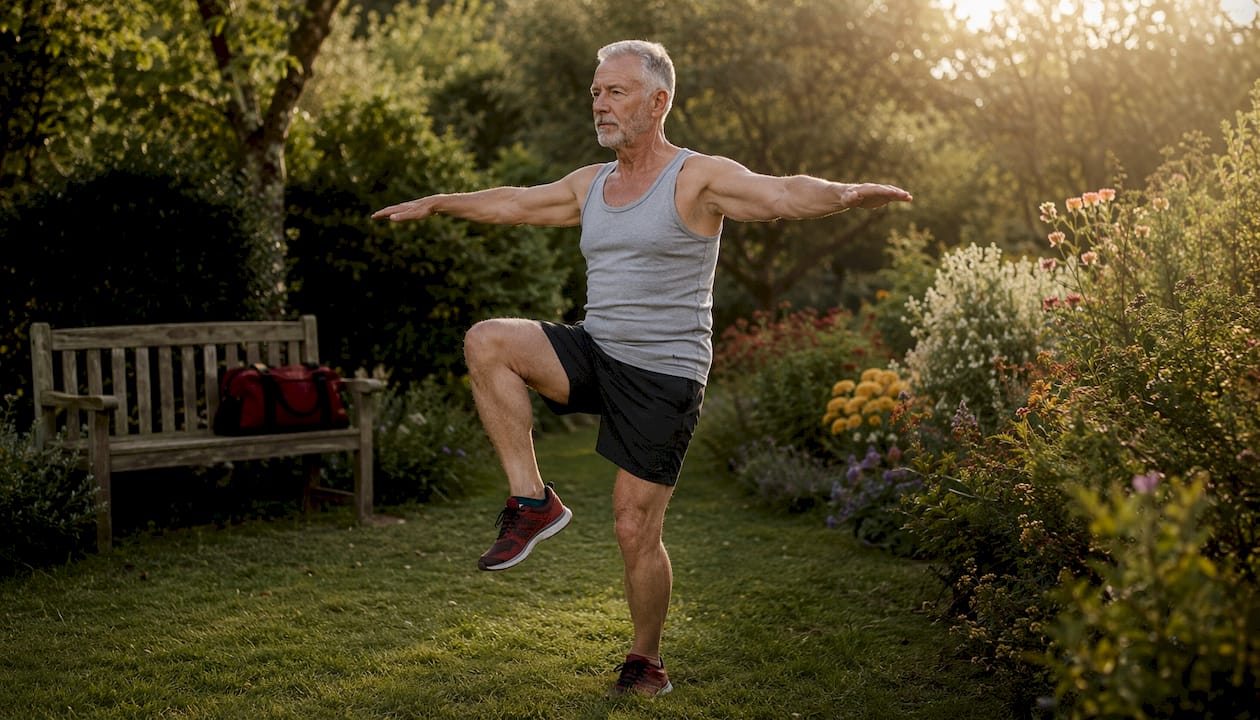
The interconnection matters practically. Stronger legs improve balance. Better hip mobility lets you generate more power in a golf swing or a tennis serve. Strength, cardio, balance, and flexibility are interdependent — modest investment across all four domains consistently outperforms heavy specialization in one. A one-size-fits-all prescription is inadequate for aging athletes whose sport demands, injury histories, and functional baselines vary widely.
Rehearsing daily movement patterns — squatting, hinging, carrying — preserves functional independence more effectively than isolated machine work. The “use it or lose it” principle applies especially hard to mobility: joints that stop moving through full range lose that range within weeks.
How do you program frequency, intensity, and progression safely?
Distribute training components across the week with purpose, not just habit.
| Component | Frequency | Intensity guidance | Progression trigger |
|---|---|---|---|
| Strength | 2–3 days/week | RPE moderate to hard; 8–12 reps | Add load when last 2 reps feel easy for 2 consecutive sessions |
| Power | 1–2 days/week | Low load, maximal velocity intent | Increase distance/height when form is consistent |
| Balance | Daily, 5–10 min | Challenging but controlled | Reduce base of support or close eyes |
| Aerobic | 5 days/week | Moderate (can hold a conversation) | Add 5–10 min/week until 150 min/week is reached |
| Mobility | Every session | Comfortable end-range | Progress to loaded stretching when passive range is stable |
Progression rules:
- Never increase load and volume in the same week.
- Add velocity before adding load for power exercises.
- If soreness exceeds 48 hours, reduce volume by 20% the next session.
- Deload every fourth week: cut volume by 30–40%, keep intensity.
- Advance complexity (single-leg, unstable surface, cognitive dual-task) only after the base movement is solid.
Brief, home-based functional strength programs with high adherence produce measurable gains — one 12-week trial showed participants completing exercises on 81% of days improved significantly on the 5x sit-to-stand and single-leg stance tests.
Which exercises should aging athletes actually train?
Six movement patterns cover the functional demands of sport and daily life. Map every exercise to one of them.
- Squat/sit-to-stand: Bodyweight chair squat → goblet squat → front squat; sit-to-stand is the entry point for anyone rebuilding lower-body strength
- Hinge: Romanian deadlift with dumbbells → trap-bar deadlift → single-leg RDL
- Step-up/single-leg: Box step-up → lateral step-up → single-leg press
- Push: Wall push-up → incline push-up → overhead dumbbell press
- Pull: Seated band row → TRX row → single-arm dumbbell row
- Carry: Farmer carry with light dumbbells → suitcase carry → overhead carry
At-home routines using resistance bands, dumbbells, and bodyweight can meet US activity guidance when structured intelligently across the week. Add medicine-ball chest passes or overhead throws for power, and hip-90/90 stretches, thoracic rotations, and ankle circles for mobility.
Equipment minimum: two pairs of dumbbells (light and moderate), a resistance band set, and a sturdy chair. A suspension trainer expands options significantly without taking up floor space.
Two weekly templates you can run starting Monday
Beginner 3-day split
| Day | Focus | Example session |
|---|---|---|
| Monday | Strength A | Sit-to-stand 2×10, goblet squat 2×10, band row 2×12, heel raise 2×12 |
| Wednesday | Aerobic + balance | 30-min brisk walk + 5-min single-leg stance practice |
| Friday | Strength B | Step-up 2×10/side, push-up 2×8, RDL 2×10, farmer carry 2×20 m |
| Daily | Mobility | 5-min hip/ankle/thoracic circuit each morning |
Sport-specific 4–5 day week
- Monday: Power + strength (medicine-ball throws, trap-bar deadlift, step-up)
- Tuesday: Sport-skill practice + aerobic (30–40 min moderate)
- Thursday: Strength + balance (single-leg work, overhead press, TRX row)
- Friday: Sport-skill + power (reactive drills, lateral bounds, carries)
- Saturday: Active recovery (yoga, swimming, or 30-min walk)
Both templates build toward the active aging fitness goals that keep athletes competing longer.
How do you modify safely and spot real red flags?
Stop training and seek medical attention for: chest pain or pressure, new shortness of breath at rest, sudden dizziness or loss of balance, sharp joint pain (not muscle fatigue), or heart palpitations.
Common programming mistakes and fixes:
- Starting too heavy: Use the baseline tests to set load, not ego. If the 5x sit-to-stand takes more than 10 seconds, bodyweight-only for the first two weeks.
- Skipping mobility: Tight hips and ankles force compensations that load the spine. Ten minutes of mobility work prevents weeks of setback.
- Ignoring medications: Beta-blockers blunt heart rate response, making RPE a better intensity guide than heart rate. Diuretics increase dehydration risk. Corticosteroids accelerate bone loss — prioritize weight-bearing work and discuss calcium and vitamin D with a clinician.
- Bone-health gaps: Osteoporosis changes exercise selection. Avoid loaded spinal flexion; favor hip-hinge patterns and impact-loading progressions.
A senior fitness safety checklist helps catch these issues before they become injuries. For joint pain that persists beyond two sessions, refer to a physical therapist before progressing load.
Pro Tip: Strengthening around the hip and ankle joints often delivers better fall-prevention results than balance boards alone. Overemphasis on unstable surfaces can build a skill that doesn’t transfer to real-world movement.
| Situation | Modification |
|---|---|
| Knee pain on squats | Reduce depth; try box squat or leg press |
| Shoulder impingement | Sub landmine press for overhead press |
| Low back sensitivity | Replace deadlift with hip thrust or cable pull-through |
| Poor grip strength | Use straps for carries; prioritize grip-specific work separately |
How do you measure progress and know when to change the plan?
Retest functional benchmarks every 4–8 weeks for strength and mobility, every 2–4 weeks for balance checkpoints.
| Metric | Retest interval | Change-plan trigger |
|---|---|---|
| 5x Sit-to-Stand time | 12 weeks | No improvement after 2 cycles → adjust load or pattern |
| TUG | 12 weeks | Improvement <1 second → add balance complexity |
| Single-leg stance | 4 weeks | Plateau in sit-to-stand time → add hip-strengthening |
| Load lifted (key lifts) | 4 weeks | Stall for 2 sessions → apply deload then reload |
| Medicine-ball throw distance | 8 weeks | Power proxy for sport-readiness |
| Training RPE | Every session | Consistently <5 → increase load or complexity |
A progress tracking checklist makes these retest decisions systematic rather than guesswork. Structured programs lasting more than 12 weeks with high adherence are associated with the most favorable functional outcomes — roughly 20–40% improvement in 30-second chair stand performance and 1.0–2.5 second reductions in TUG time.
What recovery and nutrition do aging athletes actually need?
Protein is the non-negotiable. Older muscle tissue is less sensitive to anabolic signals, so hitting 1.2–1.6 grams of protein per kilogram of bodyweight daily supports muscle maintenance. Distribute intake across meals rather than loading it at dinner. A nutrition approach for senior muscle health covers the specifics in detail.
- Sleep: 7–9 hours is the target. Recovery capacity genuinely decreases with age — two hard sessions back-to-back that a 30-year-old shrugs off can leave a 65-year-old under-recovered for days.
- Hydration: Thirst sensation diminishes with age. Drink before you feel thirsty, especially on training days.
- Supplements to discuss with a clinician: Vitamin D (bone health and muscle function), calcium (especially with corticosteroid use), and creatine monohydrate (emerging evidence for muscle preservation in older adults).
- Rest days: At least two full rest or active-recovery days per week for athletes training four or more days.
Consistent training habits matter more than any single recovery protocol. Short, daily efforts beat sporadic long sessions for aging athletes.
Does functional training actually help the brain?
Yes, and the effect is meaningful. Research published in JAMA Network Open found that people with higher physical activity levels in midlife and late life had a more than 40% lower risk of dementia compared to those with the lowest activity levels. Aerobic exercise drives much of this benefit, but dual-task training — combining movement with a cognitive challenge — appears to amplify it.
Practical integration: call out a color or number while the athlete performs a step-up sequence. Add a reaction component to carries (respond to a verbal cue to change direction). These small additions turn a physical drill into a brain-body workout without adding time. Balance training that requires attention — navigating an obstacle course rather than standing on a foam pad — produces better cognitive transfer than static drills.
What actually keeps older athletes training long-term?
Adherence beats intensity for aging athletes. Very short, daily strength-focused sessions can deliver measurable functional improvements when performed consistently — the FAST-2 trial achieved 81% adherence with a four-minute daily protocol, which is a higher completion rate than most traditional gym programs.
Practical adherence strategies:
- Anchor training to an existing habit (after morning coffee, before the evening news).
- Set performance goals, not appearance goals. “Complete the TUG in under 10 seconds” is more motivating than “lose weight” for most athletes over 60.
- Train with a partner or coach at least once per week. Social accountability is one of the strongest adherence predictors across age groups.
- Track something visible. A simple log of reps, times, or distances gives the brain a reward signal that keeps the habit alive.
- Celebrate functional wins. Carrying groceries without fatigue, climbing stairs without holding the rail — these are the outcomes that matter.
Which apps and tools help with tracking and adherence?
Technology works best when it reduces friction, not adds it. A few categories worth using:
Wearables: Garmin and Apple Watch both track heart rate, daily steps, and sleep quality — useful for monitoring aerobic volume and recovery. The heart rate variability (HRV) trend is a practical recovery signal for aging athletes.
Training apps: TrueCoach and TrainHeroic allow coaches to deliver video-guided programs with built-in progress logging, which mirrors the video-coaching model that drove high adherence in the FAST-2 trial. For self-directed athletes, Strong (iOS/Android) handles session logging cleanly.
Assessment tools: The 30-second chair stand and TUG can be timed with any smartphone stopwatch. Recording the test on video adds a qualitative layer that numbers alone miss.
Telehealth and remote coaching: For athletes outside major metros, video-based coaching sessions remove the commute barrier that often kills adherence in older populations.
Bodiesbymahmood brings these best practices to your training
Knowing the evidence is one thing. Having a coach who applies it to your sport, your body, and your goals is another.

Bodiesbymahmood is an Orlando-based sports and fitness facility built specifically for athletes — from weekend competitors to professionals — who want results that transfer to their sport, not just better gym numbers. With over 25 years of experience and trainers who come from college and professional sports backgrounds, the team runs the full assessment protocol described in this guide: baseline functional tests, individualized program design, progressive overload built around your sport demands, and regular retesting to keep the program honest. The facility combines the equipment access of a public gym with the focused attention of a private training environment. Whether you need a personal training program built around your functional baseline or want to explore membership options, the next step is straightforward: book your assessment and find out exactly where you stand.
Key Takeaways
Multicomponent, individualized, progressive functional training is the single most effective approach for aging athletes who want to maintain sport performance and independence.
| Point | Details |
|---|---|
| Run baseline tests first | Use the 5x sit-to-stand, TUG, and single-leg stance to set starting loads and track real progress. |
| Train all five components | Strength, power, balance, aerobic, and mobility work together — dropping one creates a gap that sport exposes. |
| 150 minutes/week aerobic floor | US guidance sets 150 minutes of moderate aerobic activity plus 2+ strength days as the weekly minimum. |
| Adherence beats intensity | Short, consistent daily sessions outperform sporadic hard efforts for aging athletes over any 12-week period. |
| Bodiesbymahmood | Orlando-based sports-specific training with 25+ years of experience; offers full assessment and individualized programming for aging athletes. |
Why the conventional wisdom on senior fitness undersells aging athletes
Most senior fitness content is written for frailty prevention, not sport performance. That framing is useful for some populations, but it quietly tells aging athletes that their ceiling is “staying functional” rather than “staying competitive.” The evidence does not support that ceiling.
Multicomponent training with genuine progressive overload produces strength and mobility gains in adults well into their 70s and 80s. The limiting factor is almost never biology — it is program design. Coaches who document baseline functional status, track comorbidities, and build individualized progressions consistently get better outcomes than those who apply a generic “senior class” template. The research on brief daily functional training makes this even clearer: four minutes a day, done consistently, moved the needle on functional performance in adults with pre-existing walking difficulty. That is not a ceiling. That is a floor.
The athletes who stay competitive longest are not the ones who trained hardest in their 40s. They are the ones who trained smartly enough in their 50s and 60s to keep showing up. Power work, sport-specific movement, and honest progress tracking are not luxuries for older athletes. They are the prescription.
Select references and recommended reading
- Harvard Health: Functional fitness and age-related changes — strength and power decline rates; foundational justification for urgency
- Harvard Health: Age and muscle loss — US physical activity guidelines and muscle maintenance context
- Harvard Health: Stay strong at any age — practical exercise descriptions and 5x sit-to-stand benchmarks by age
- Harvard Health: Three moves for functional fitness — sit-to-stand, step-up, and carry exercise guidance
- PubMed: Expert consensus on multicomponent training — clinical gold-standard recommendation for older adults
- Frontiers in Medicine: Impact of exercise on functional fitness in older adults — systematic review of 95 trials; strength, TUG, and gait speed outcomes
- PLOS One: FAST-2 brief daily functional RT trial — adherence data and functional outcomes for short daily programs
- National Institute on Aging: Exercise and physical activity — movement-pattern rationale and daily activity guidance
- MSD Manual: Exercise in older adults — clinical screening and tailored program guidance
- TRX Training: Functional exercises for seniors — exercise variations, regressions, and low-equipment options
- Healthline: Exercise plan for older adults — multi-domain programming overview and safety notes