


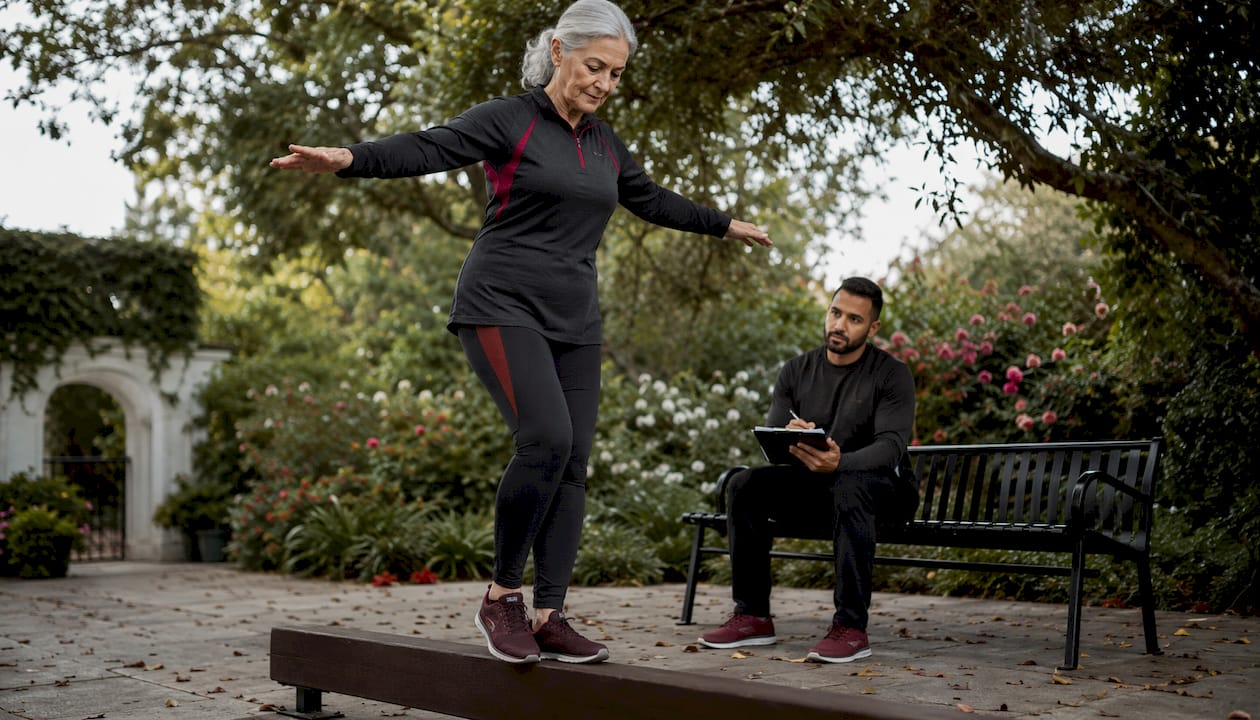
A senior fitness assessment is the process of evaluating your current strength, balance, endurance, and flexibility to build a safe, personalized exercise program. Skipping this step is the most common mistake seniors make when starting a fitness routine. The Senior Fitness Test, a standardized battery of 6–7 stations, gives you a clear picture of where you stand in about 20 minutes. This guide walks you through every step of a senior fitness assessment getting started process, from medical clearance to your first workout plan, so you move forward with confidence and zero guesswork.
Why medical clearance matters before your senior fitness assessment
Medical clearance is not a formality. It is a safety check that protects you from serious harm during testing and training.
Seniors should consult a physician before starting any new exercise program, especially those with heart disease, diabetes, or metabolic conditions. Routine ECGs are rarely necessary, but a physician can flag conditions that change how you test and train. Skipping this step risks pushing through undetected cardiac issues or joint problems that a brief conversation with your doctor would have caught.

A simple screening tool called the PAR-Q+ (Physical Activity Readiness Questionnaire for Everyone) is a standard first step many fitness professionals use. It asks about chest pain, dizziness, bone or joint problems, and medication use. Answering “yes” to any question does not disqualify you from exercise. It means you need a physician’s input before proceeding.
The Medicare Annual Wellness Visit includes a functional and health risk assessment at no additional cost for eligible seniors. This visit covers physical, cognitive, and social health factors. Use it as your starting point before any formal fitness testing.
Conditions that require extra care before testing:
- Arthritis or joint replacements: avoid high-impact or deep-range movements during testing
- Uncontrolled high blood pressure: get clearance before any aerobic testing
- Recent surgery or fracture: wait for physician sign-off before strength tests
- Dizziness or balance disorders: have a spotter present during all standing tests
- Medications like beta-blockers: these affect heart rate, which changes how you interpret aerobic results
Pro Tip: Bring a written list of all medications to your physician visit. Some drugs affect heart rate, blood pressure, and muscle function in ways that directly change your test results.
Which fitness tests should you perform?
The Senior Fitness Test is the gold standard for evaluating functional capacity in older adults. It covers the physical abilities you use every single day.

The test includes seven stations: the 30-second chair stand, arm curls, 6-minute walk, sit-and-reach, back scratch, 8-foot up-and-go (also called the Timed Up and Go), and a 2-minute step test as an aerobic alternative. Each station maps directly to a real-world task. Chair stands reflect your ability to get up from a seat. The 8-foot up-and-go measures how quickly you rise, walk, and return to sitting, which predicts fall risk.
Here is how to perform the core tests safely:
- 30-second chair stand: Sit in a sturdy chair with arms crossed over your chest. Rise to full standing and return to sitting as many times as possible in 30 seconds. Count only complete stands.
- Arm curl: Hold a dumbbell (5 lbs for women, 8 lbs for men) at your side. Curl it to shoulder height and lower it fully. Count repetitions in 30 seconds.
- 6-minute walk: Mark a measured course of 50 yards. Walk as far as possible in 6 minutes without running. Record total distance.
- Sit-and-reach: Sit at the edge of a chair, extend one leg, and reach toward your toes. Measure the distance between your fingertips and the sole of your foot.
- 8-foot up-and-go: Start seated. On “go,” stand, walk around a cone 8 feet away, and return to sitting. Record the time in seconds.
Pro Tip: Always have someone with you during testing. A spotter prevents falls and records your scores accurately, which matters more than you might expect.
Movement quality during tests matters as much as the score itself. Pushing off your knees during a chair stand, for example, inflates your count but hides a real strength deficit. Note any compensations you observe alongside the numbers.
| Test | What it measures | Equipment needed |
|---|---|---|
| 30-second chair stand | Lower-body strength | Sturdy chair |
| Arm curl | Upper-body strength | Dumbbell (5–8 lbs) |
| 6-minute walk | Aerobic endurance | Measured course, timer |
| Sit-and-reach | Lower-body flexibility | Chair, ruler |
| 8-foot up-and-go | Dynamic balance and agility | Chair, cone, stopwatch |
How do you interpret your fitness test results?
Fitness test scores are diagnostic tools, not pass-or-fail grades. Tests identify specific functional deficits so you can target training where it counts most.
A low chair stand score points to lower-body strength as your priority. A slow 8-foot up-and-go time, typically above 12 seconds, signals a meaningful balance and mobility concern. A short 6-minute walk distance suggests aerobic endurance needs attention. None of these results label you as unfit. They show you exactly where to focus.
Document both your numbers and your movement quality. Write down how each test felt, whether you needed to pause, and any compensations you noticed. This qualitative record is often more useful than the score alone when you revisit the assessment in 8–12 weeks.
Fitness scores tell you where to start, not who you are. A senior who scores low on the chair stand today and trains consistently for three months will almost always outscore the person who skipped the assessment entirely and trained without direction.
Programs must prioritize the weakest functional links identified in your assessment, not generic age-based protocols. Age alone tells you almost nothing about what a person needs. Two 70-year-olds can have wildly different strength, balance, and endurance profiles. Your assessment data is the only reliable guide.
Common result patterns and what they mean:
- Low chair stand score: prioritize lower-body strength training, specifically chair rises, step-ups, and leg press movements
- Slow 8-foot up-and-go: focus on gait drills, turning practice, and dynamic balance work
- Short 6-minute walk distance: build aerobic base with low-intensity steady walking or cycling
- Poor sit-and-reach: add daily hip flexor and hamstring stretching to your warm-up
- Arm curl below average: include upper-body pressing and pulling exercises two days per week
How do you build a fitness program from your assessment?
Your assessment results are a direct blueprint for your exercise program. Standing, weight-bearing, multi-joint exercises produce better functional outcomes than machine-based or seated-only routines.
Start with movements that mirror what you do at home. Chair rises build the exact strength you need to get up from a couch or car seat. Walking lunges and step-ups train the hip and knee control that keeps you stable on stairs. These are not gym exercises borrowed from a younger person’s program. They are functional fitness movements designed around your daily life.
Balance training must go beyond standing on one foot. Training direction changes, head turns while walking, and stepping over objects improves dynamic balance far more effectively than static drills. Falls happen during movement, not while standing still. Your program should reflect that reality.
Core program principles based on assessment findings:
- Train three days per week with at least one rest day between sessions
- Begin each session with 5–10 minutes of light walking or marching in place
- Prioritize your two lowest-scoring test areas in every session
- Add one new exercise or increase resistance only after completing three sessions at the current level without difficulty
- Reassess every 8–12 weeks using the same tests to measure real progress
Pro Tip: Keep a simple training log. Write down the exercise, the weight or resistance, and how it felt on a scale of 1–10. This takes two minutes and makes your next reassessment far more informative.
25% of older adults have low muscle mass, a condition called sarcopenia, which raises fall risk by 40%. Strength training twice per week directly addresses this. You do not need heavy weights. Resistance bands, light dumbbells, and bodyweight movements are enough to build meaningful strength when applied consistently.
Equipment does not need to be expensive. A sturdy chair, a set of resistance bands, and a pair of light dumbbells cover most of what you need at home. If you train at a facility like Bodiesbymahmood, a trainer can supervise your form and progress your program safely based on your actual assessment data. You can also explore seated strength training options if standing exercises are not yet appropriate for your current level.
Key Takeaways
A structured senior fitness assessment is the most reliable way to build a safe, effective exercise program that targets your actual physical needs rather than assumptions based on age.
| Point | Details |
|---|---|
| Medical clearance first | See a physician before testing, especially with heart, metabolic, or joint conditions. |
| Use standardized tests | The Senior Fitness Test covers strength, balance, endurance, and flexibility in about 20 minutes. |
| Record quality, not just scores | Note movement compensations alongside numbers to get an accurate picture of functional status. |
| Target your weakest links | Build your program around your lowest-scoring areas, not a generic age-based routine. |
| Reassess every 8–12 weeks | Repeat the same tests to measure real progress and adjust your program accordingly. |
What I’ve learned from training seniors over 25 years
Most seniors I work with arrive thinking the assessment will confirm their worst fears. They expect to be told they are too old, too weak, or too far behind to make real progress. That fear is understandable. It is also completely wrong.
The assessment does the opposite. It gives you specific, honest information about where you are right now. That information removes the guesswork and replaces it with a clear direction. I have watched people in their 70s and 80s improve their chair stand scores, cut their 8-foot up-and-go times, and walk farther in six minutes than they could a year earlier. None of that happened by accident. It happened because they started with an honest assessment and trained toward what the data showed.
The biggest mistake I see is seniors skipping the assessment and jumping straight into a generic program. They work hard for months and wonder why they are not improving. The answer is almost always that they trained the wrong things. A person with a balance deficit who spends all their time on a stationary bike will get fitter aerobically but will still fall. Assessment-driven training fixes that.
Patience matters more than intensity at this stage. The goal is not to train as hard as possible. The goal is to train consistently, progress gradually, and protect the function you have while building more. That is a realistic, achievable target for almost every senior who walks through our doors at Bodiesbymahmood.
— Mahmood
Bodiesbymahmood’s approach to senior fitness and assessment
Bodiesbymahmood has worked with adults of all ages for over 25 years, and senior fitness is one of the areas where personalized guidance makes the biggest difference.
At Bodiesbymahmood in Orlando, every senior program starts with a structured assessment before a single workout is designed. Trainers with professional sports and college-level education backgrounds evaluate your strength, balance, endurance, and flexibility, then build a program around what your results actually show. You get the private gym attention of a one-on-one session inside a full-service facility. If you are ready to assess your current level and train with a plan that fits your body and your goals, personal training at Bodiesbymahmood is the place to start.
FAQ
What is a senior fitness assessment?
A senior fitness assessment is a structured evaluation of strength, balance, endurance, and flexibility using standardized tests like the Senior Fitness Test. It identifies functional deficits and guides the design of a safe, personalized exercise program.
How do I assess my current fitness level as a beginner?
Start with medical clearance from your physician, then complete the core Senior Fitness Test stations: the 30-second chair stand, 8-foot up-and-go, 6-minute walk, and sit-and-reach. Record both your scores and any movement compensations you notice.
Why does senior fitness assessment matter before starting exercise?
Fitness tests identify specific weaknesses that a generic program will miss, reducing injury risk and improving results. Seniors who train based on assessment data target the right areas from day one.
How often should seniors repeat a fitness assessment?
Reassess every 8–12 weeks using the same tests under the same conditions. This gives you an accurate measure of progress and tells you when to adjust your program.
Can I do a senior fitness assessment at home?
Most Senior Fitness Test stations require only a sturdy chair, a light dumbbell, a timer, and a measured walking space. A spotter is strongly recommended for safety during all standing tests.