


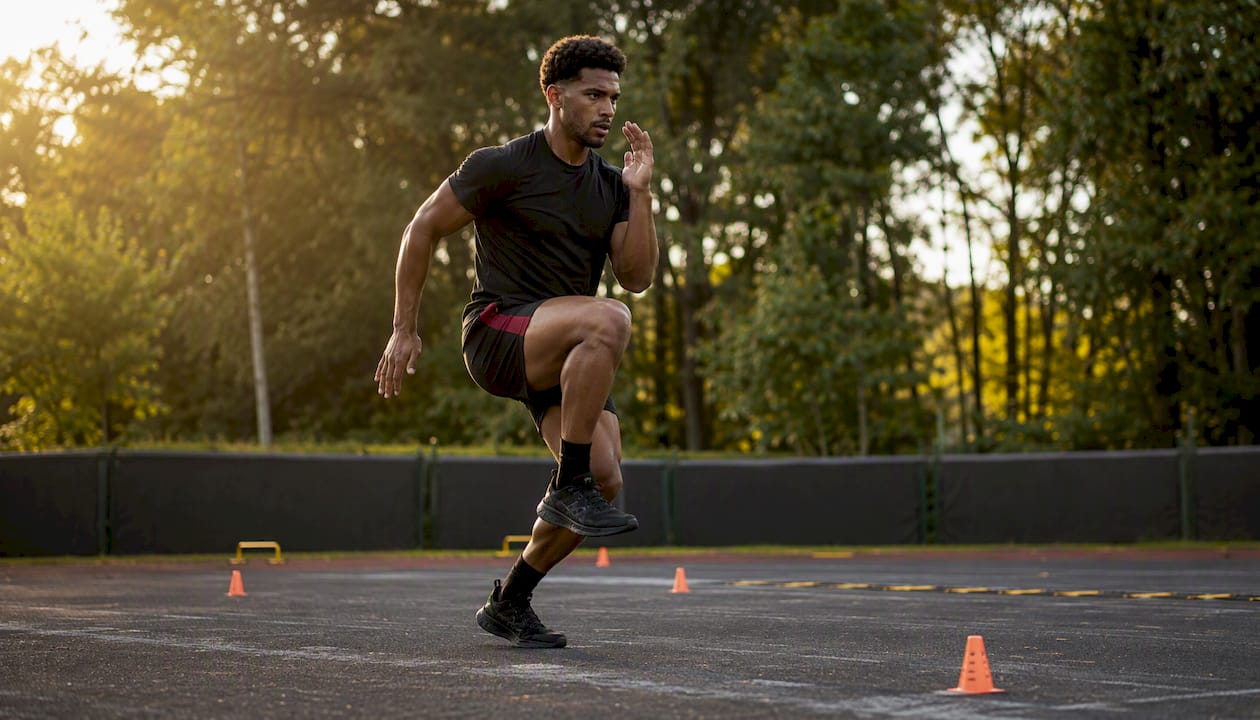
The eight drills that move the needle for sprint speed are the A-march, A-skip, A-run, B-skip, wall drives, falling starts, build-ups, and sprint-float-sprint. Each one targets a specific phase of the sprint stride. A-march and A-skip build front-side mechanics and hip flexion rhythm. Wall drives and falling starts fix drive-phase posture. B-skip trains hip extension and the recovery snap of the lower leg. Build-ups and sprint-float-sprint connect slow, controlled patterns into race-speed running.
Here’s the drill-to-purpose map every coach should have memorized before writing a single warm-up:
- A-march — hip flexion, knee lift rhythm, and posture at low speed. Cue: “tall spine, knee to hip height.”
- A-skip — same pattern with a rhythmic hop added for timing and elastic response. Cue: “quick ground contact, don’t sink.”
- A-run — the A-skip pattern layered onto forward momentum, the closest drill to actual sprinting. Cue: “stay tall, drive forward, not up.”
- B-skip — teaches full leg extension followed by an active pull-back before ground contact. Cue: “paw the ground, don’t reach.”
- Wall drives — isolates drive-phase shin angle and hip extension against a fixed surface. Cue: “push the wall away, not just lean.”
- Falling starts — teaches the body to fall into acceleration angles rather than pop upright too soon. Cue: “let gravity start the drive.”
- Build-ups — progressive accelerations from jog to near-top speed over 30 to 60 meters. Cue: “gears, not a jump to top gear.”
- Sprint-float-sprint — alternating hard acceleration with relaxed cruising to train speed maintenance. Cue: “relax the face and hands on the float.”
Most of these belong in the warm-up or the pre-max-velocity block of a session, run at low to moderate effort. Build-ups and sprint-float-sprint run at higher intensity, and act as the last step before full-speed reps.
Key Takeaways
Sprint mechanics drills build the neuromuscular patterns for good technique, but only high-intensity sprinting paired with a structured progression converts that technique into real speed.
| Point | Details |
|---|---|
| Prioritize the bridging drills | Build-ups and sprint-float-sprint connect isolated technical work to actual race-speed running. |
| Progress slow to fast, simple to complex | Master leg-only patterns before adding arms, and validate every drill with timed sprints. |
| One cue at a time | Stacking multiple corrections in a single rep overloads the athlete and worsens execution. |
| Cap drill volume, protect recovery | Novice sprinters should limit near-max effort distance per session to moderate volumes. |
| Bodies by Mahmood pairs drills with sprint testing | Sessions start with a movement screen and baseline sprint test to build an individualized drill plan. |
Table of Contents
- Why sprint mechanics drills matter and what they won’t fix
- Building a sprint mechanics drill bank by category
- How should drills progress across a training cycle?
- What coaching cues fix the most common sprint faults?
- How much drill volume is safe, and how do you avoid injury?
- Does the research support drill-based sprint training?
- A coach’s honest take on drill volume
- How Bodies by Mahmood turns sprint drills into real speed gains
- Sources
Why sprint mechanics drills matter and what they won’t fix
Drills build the neuromuscular patterns and body awareness that let an athlete’s nervous system rehearse sprint positions at a controllable speed. They do not, by themselves, make anyone faster. The clearest statement of this comes from Track & Field News, which points out that drills reinforce mechanical patterns, but real speed development requires sprinting at near maximal intensity. A perfectly executed A-skip at half speed teaches the shape of the movement. It doesn’t teach the timing, the ground reaction forces, or the arm-leg coordination that shows up only when the body is actually sprinting.
That’s backwards. Sports-science research on elite sprint development frames drills as one piece of a larger puzzle that has to include actual sprinting, technical work, strength and power training, and plyometrics, all periodized together rather than treated as separate boxes to check.
- Drills isolate a movement feature so the athlete can feel it without the chaos of full speed.
- Sprinting is what converts that feeling into usable, race-speed technique.
- A drill that never gets paired with sprinting within the same session or week is producing very little transfer.
- If a drill still looks awkward after several reps, that’s a signal of a genuine mechanical gap, not a rep count problem.
Pro Tip: Film three reps of the drill and three reps of an actual sprint from the same angle, then watch them back to back. If the drill position never shows up in the sprint stride, the drill isn’t transferring, and it’s time to change the cue, the setup, or the drill itself.
Practically, this means putting drills where they belong on the clock. Run them early in the session while the nervous system is fresh but not yet fatigued, then move into build-ups and finally into near-max sprints. A session that ends with drills and never touches high speed has taught the brakes, not the accelerator.
Building a sprint mechanics drill bank by category
A useful drill bank isn’t a giant list. It’s a short set of movements, each doing a distinct job, organized by the phase of the sprint they train. PursuitPE’s coaching framework reduces sprint technique to three pillars, posture, projection, and rhythm, and argues coaches should keep the drill menu tight and always pair drills with actual sprinting rather than running an ever-expanding catalog of variations.
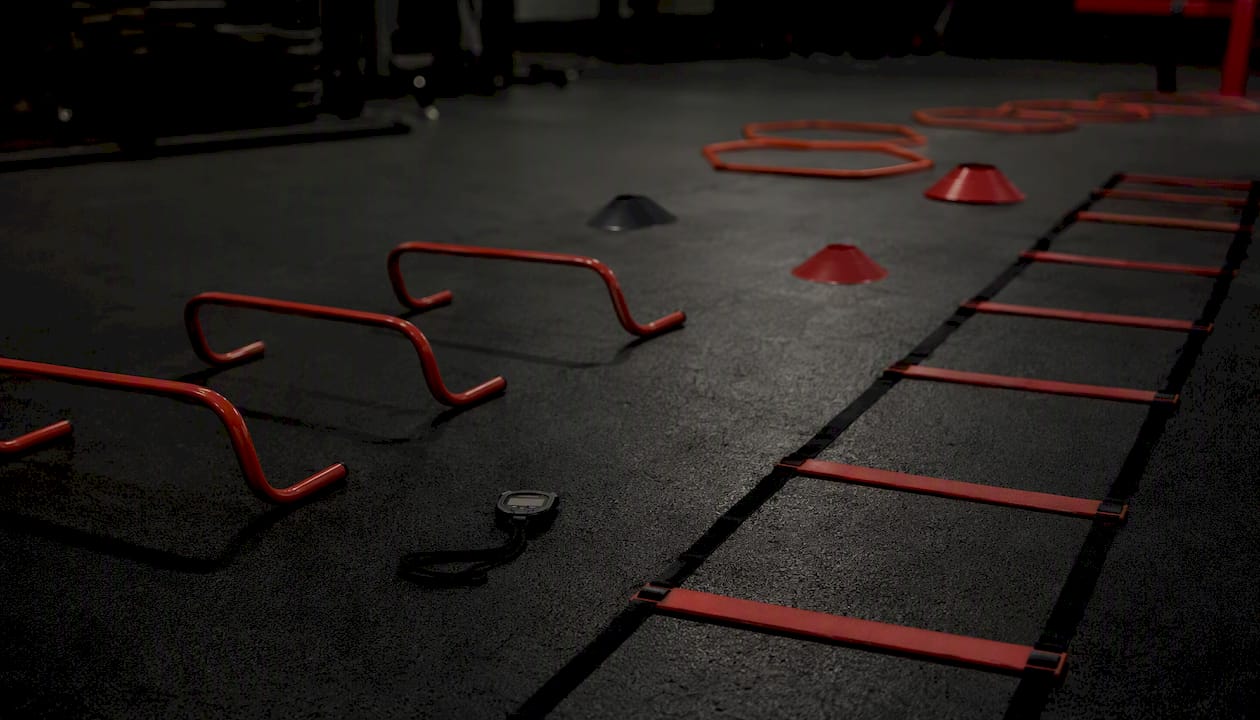
Pre-acceleration and starts
Falling starts and 3-point or block starts teach the shin angles and body lean that convert stored power into forward drive. Olympic-level coaching guidance treats the first 10 to 20 meters as the phase that decides much of the race, driven by precise foot placement and hip and ankle angles at the moment of push-off.
- Set up in a staggered stance, lean forward until balance breaks, and catch the fall with the first step.
- Keep the head neutral, eyes down, and resist popping the chest up early.
- Drive the arms opposite the legs from the very first stride.
- Common error: standing up too soon. Fix: cue “stay low for five steps” and mark a line on the track five meters out.
- Distance: 10 to 20 meters. Intensity: near-max on the drive, controlled recovery walk-back.
Drive-phase posture: wall drives
Wall drives isolate the shin angle and hip drive without the balance demands of an actual start.
- Lean into a wall or fence at roughly a 45-degree angle, hands at shoulder height.
- Drive one knee up and forward, then snap the foot down under the hip.
- Alternate legs, keeping the torso rigid and the support leg extended.
- Common error: bending at the waist instead of leaning from the ankle. Fix: cue “one straight line from ankle to shoulder.”
- Distance/reps: 3 sets of 8 to 10 drives per leg. Intensity: moderate, focus on position over speed.
Front-side mechanics: A-march, A-skip, A-run
This is the progression Atleta Explosivo’s drill guides recommend building through in order, starting with the arms removed entirely so the athlete isn’t managing two coordination problems at once.
- A-march: walk forward, driving each knee to hip height, toes up, then stepping down under the body. No arm swing at first.
- A-skip: add a small hop on the support leg as the opposite knee drives up, creating rhythm.
- A-run: carry the same pattern into a light jog, letting forward momentum build naturally.
- Common error: reaching the foot forward on the way down, which brakes momentum. Fix: cue “stomp it straight down, not out.”
- Distance: 15 to 20 meters per rep. Intensity: 50 to 70% for warm-up sets, faster for A-run reps closer to a session’s technical work.
Once the leg pattern looks clean without arms, reintroduce arm action. Progression research on fixing mechanical faults is blunt about this order: adding arms too early increases the coordinative load and usually causes the legs to regress.
Extension and recovery: B-skip and straight-leg bounds
The B-skip adds a piece the A-series doesn’t touch: the active pull-back of the foot right before it strikes the ground, which mimics the “paw” action sprinters use to minimize braking force.
- From the A-skip position, extend the leg forward slightly, then actively pull it back and down.
- Keep the pull-back sharp and close to the ground, not a long reach.
- Straight-leg bounds reinforce the same extension pattern over longer, faster strides.
- Common error: letting the leg extend too far forward, creating a braking heel strike. Fix: cue “claw it back before it lands.”
- Distance: 15 to 20 meters. Intensity: 60 to 80%, sharper on the pull-back than the earlier drills.
Bridging drills: build-ups and sprint-float-sprint
These two drills exist to connect isolated technical work to actual race speed, and they belong late in a technical session, right before or in place of pure sprint reps.
-
Build-ups: start at a jog, add speed every 10 meters until reaching 90 to 95% by the final third.
-
Sprint-float-sprint: accelerate hard for 20 meters, relax and cruise for 20, then re-accelerate for 20.
-
Common error: forcing effort during the “float,” which defeats the drill’s purpose. Fix: cue “relax the jaw and hands, let the legs keep moving.”
-
Distance: 40 to 60 meters total. Intensity: 80 to 95%.
| Drill | Typical distance | Target intensity | Typical rest |
|---|---|---|---|
| A-march / A-skip | moderate distance | low to moderate intensity | rest as needed |
| A-run | moderate distance | moderate intensity | rest as needed |
| B-skip / straight-leg bounds | moderate distance | moderate intensity | rest as needed |
| Wall drives | multiple reps per leg | moderate, position-focused | rest as needed |
| Falling starts | short distance | high intensity on drive | extended rest |
| Build-ups | moderate to longer distance | progressive to high intensity | longer rest |
| Sprint-float-sprint | moderate to longer distance | high intensity on float and drive segments | longer rest |
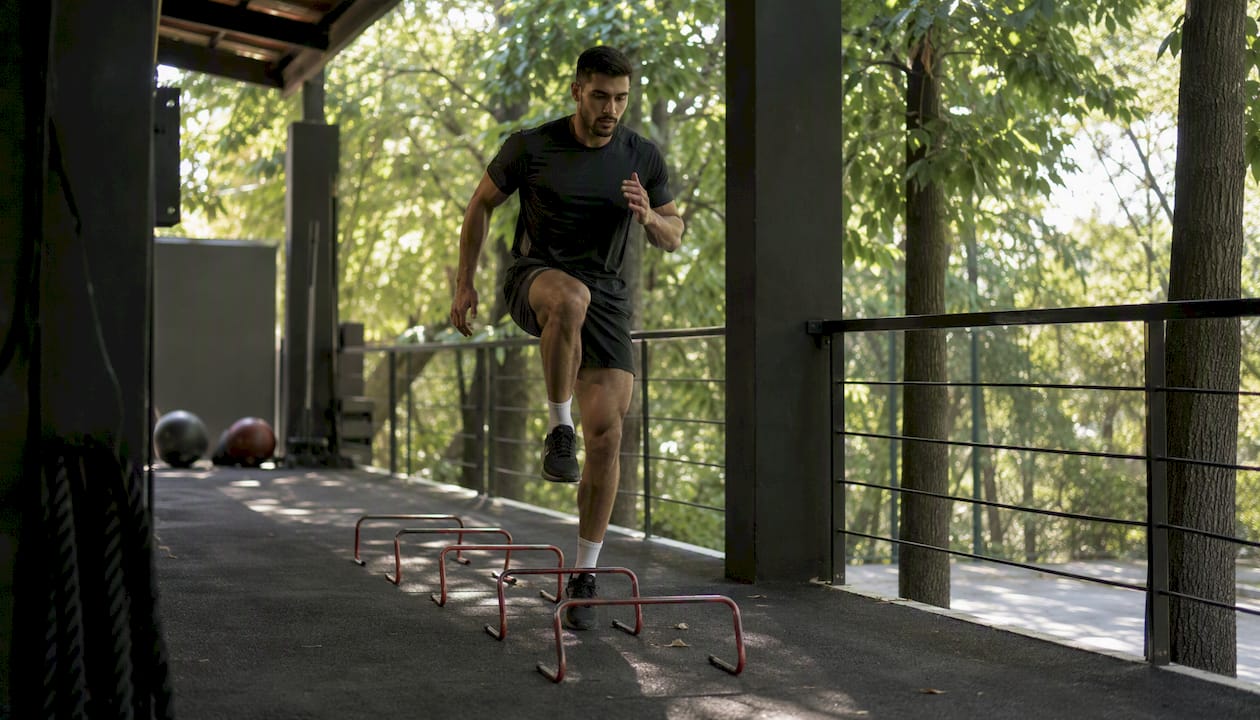
Pro Tip: Add mini-hurdles or wickets to A-skip and A-run work when an athlete’s heel recovery is lazy. The spacing forces a faster knee-and-heel cycle without you having to say a word, and progressive spacing also teaches acceleration and stride length together. Changing surface or hand position occasionally also keeps the nervous system solving a slightly new problem instead of grooving a robotic, checked-out repetition, a variation principle Track & Field News specifically recommends over running the same drill the same way every week.
How should drills progress across a training cycle?
Progress from slow to fast, short to long, and simple to complex, and never assume a drill has transferred until it shows up in a high-speed rep. That’s the whole rule. Everything else is detail.
The volume and sequencing details matter more than most coaches admit. Running too many drill variations in one session dilutes focus; running the same three or four with intent, then testing them against real sprints, builds faster.
- Master the pattern without arms first. Leg-only proficiency comes before adding arm swing, since coordination demand jumps the moment both are combined.
- Add speed before adding distance. A clean 15-meter A-skip at higher tempo beats a sloppy 30-meter one.
- Reintroduce complexity gradually. Move from in-place drills to walking versions, then jogging, then near-sprint speed.
- Validate weekly with timed reps. A 10 to 30 meter timed sprint tells you whether the drill work actually moved the needle.
- Cycle drill emphasis across the week. Don’t hammer the same fault-correction drill in every session; give the nervous system recovery time between similar demands.
Here are three ready-to-use templates:
Novice or youth technical day
- Dynamic warm-up: 5 minutes light jogging, leg swings, ankle circles.
- A-march x2 (20m), A-skip x2 (20m), no arms, 60% effort.
- Wall drives, 2 sets of 8 per leg.
- Build-ups x3 (30m), building to 80%.
- Rest: full walk-back recovery between every rep.
Team-sport acceleration day
- Dynamic warm-up for sprinters, plus falling starts x3 (10m) to prime the nervous system.
- A-run x3 (20m) at 75 to 85%.
- B-skip x2 (20m).
- Falling starts x4 (15m) at 95%+.
- Build-ups x2 (40m) into a full sprint.
Sprinter speed day, max-velocity focus
- Full dynamic warm-up plus A-series drills at increasing tempo.
- Wall drives x2 sets, sharp and brief.
- Sprint-float-sprint x3 (60m total).
- Max-velocity flying sprints x4 to x6 (20 to 30m) at 95 to 100%, full recovery (3 to 5 minutes) between reps.
Drill-focused sessions generally belong in the plan one to three times per week depending on level, with novice and youth athletes leaning toward the higher end for skill acquisition and advanced sprinters leaning toward fewer, sharper drill sessions paired with more max-velocity work.
What coaching cues fix the most common sprint faults?
Eight cues cover most of what goes wrong in a sprint stride: “chest up, don’t fold,” “push the ground away,” “drive the foot under the hip, not out front,” “relax the jaw and hands,” “knee to hip height, not higher,” “claw the ground back before landing,” “stay low through the drive phase,” and “opposite arm, opposite leg, every stride.” Give an athlete more than one of these at a time and you’ll usually get worse movement, not better, because the brain can only prioritize so much at once.
| Visible error | Likely cause | Immediate cue | Follow-up drill |
|---|---|---|---|
| Overstriding, reaching foot forward | Trying to cover ground with the front leg instead of the hip | “Claw it back, don’t reach” | B-skip, straight-leg bounds |
| Standing up too early out of a start | Fear of falling, poor drive-phase confidence | “Stay low, drive for five steps” | Falling starts, wall drives |
| Heel dragging on recovery | Weak hip flexion, poor rhythm | “Knee to hip, quick and light” | A-skip with mini-hurdles |
| Arms crossing the body | Tight shoulders, lack of arm-leg coordination | “Elbows back, thumbs to pockets” | A-run with exaggerated arm cue |
| Collapsing at the hip on ground contact | Weak single-leg stability or fatigue | “Stack ankle, knee, hip” | Wall drives, single-leg holds |
| Losing speed after 30 meters | No relaxation at top speed, over-gripping effort | “Relax the face, keep the legs moving” | Sprint-float-sprint |
A fast 30-second review works better than a long breakdown. Watch one rep for foot strike position, one for posture, and one for arm action, then pick the single biggest leak and give one cue before the next rep.
Pro Tip: Never stack two corrections in the same rep. Fix the biggest issue first, let the athlete run it clean for two or three reps, then move to the next cue. Sprinting is complex enough without a coach shouting three instructions at once.
How much drill volume is safe, and how do you avoid injury?
Warm up properly, load volume progressively, and cap high-intensity reps per session, because most sprint-related soft tissue injuries show up when fatigued athletes push into max-speed work without adequate preparation. That’s the safety floor for every level.
Novice athletes should keep total high-intensity sprint volume low, generally under a moderate volume of near-max effort per session, while building drill competency at lower intensities. Intermediate and advanced sprinters can handle more total volume, but the ratio still matters: more max-effort reps require more full recovery between them, not less. Stop a session immediately for sharp pain, sudden asymmetry between limbs, or an unexplained drop in sprint times mid-session, all of which point to fatigue outrunning recovery.
- Warm up hips, ankles, and hamstrings specifically before any drill work, since these areas absorb the most sprint-specific stress.
- Dynamic mobility for sprinters should include hip flexor walks, ankle dorsiflexion rocks, and hamstring sweeps, paired with general flexibility and injury-prevention practices.
- Athletes returning from injury should regress to lower-intensity drills (A-march before A-skip, wall drives before falling starts) and rebuild volume gradually rather than jumping back into max-velocity sprints.
- Older athletes and those newer to sprint training need individualized volume caps; a program built for a college sprinter is the wrong template for a returning-to-fitness adult or a senior client, a distinction worth applying the same way senior functional fitness guidance does for other high-impact movements.
- Any drill that produces sharp, localized pain (as opposed to normal muscular fatigue) should stop immediately, not “work through.”
This is general training guidance, not a substitute for a medical evaluation. Anyone managing an existing injury or chronic condition should confirm a return-to-sprint plan with a qualified physical therapist or physician before adding drill volume back in.
Does the research support drill-based sprint training?
The evidence backs drills as a technical reinforcement tool, not a stand-alone speed developer, and transfer only happens when drill work is paired with real high-speed sprinting on a sensible progression. That’s the honest summary of where the science actually lands.
- Motor-learning principles say practice movement has to closely resemble competition movement to produce useful carryover, which is why a slow-motion drill teaches shape but not race-speed timing, a point sports-science literature on elite sprint development makes directly.
- Elite programs treat sprinting, technical drills, strength and power work, and plyometrics as one connected system rather than separate training blocks, individualized to the athlete.
- Coaches should vary the stimulus, surface, hand position, added resistance, rather than repeating identical drill patterns week after week, which keeps the nervous system engaged instead of running on autopilot.
- Awkward or clumsy drill execution after multiple attempts usually signals a real mechanical deficiency, not a lack of repetition, and should be addressed before returning the athlete to full-speed sprinting.
- A drill that never merges into the neuromuscular demands of full-speed running is likely producing minimal transfer no matter how many reps get logged.
Drills are not sprinting. If a drill never clearly merges into the neuromuscular requirements of full-speed running, it is probably unproductive, and any awkwardness the athlete shows in that drill points to a mechanical deficiency that needs fixing before returning to top-speed work.
The most practical way to check whether all this drill work is actually paying off is a timed test: run 10, 20, and 30 meter splits every few weeks and compare, or record video from the side and check whether the drill’s key position (knee height, foot strike, torso angle) shows up in the actual sprint stride. A structured sprint performance test removes the guesswork from that question.
A coach’s honest take on drill volume
Many programs focus heavily on drills and less on actual sprinting. Drills feel productive and controllable, while max-velocity sprinting is harder to manage and carries more perceived risk. An athlete who executes a flawless B-skip but has not sprinted at maximal effort in several weeks has not necessarily learned to sprint faster. They’ve learned to skip well.
The fix isn’t complicated. Cap the drill menu to four or five movements that map directly to a phase of the sprint, run them with intent for eight to ten minutes, and then get to actual sprint work in the same session. One adjustment that consistently shows up as a fast win: swapping a long, unfocused drill block for a shorter one followed immediately by build-ups into near-max sprints. Athletes who make that switch tend to see their technical cues actually show up at speed within a few weeks, because the drill and the sprint are finally happening close enough together for the nervous system to connect them.
That’s the same philosophy behind how Bodies by Mahmood structures sports-specific sessions: mechanics work exists to serve the sprint, not to replace it.
How Bodies by Mahmood turns sprint drills into real speed gains
Bodies by Mahmood has spent over 25 years building sports-specific programs where drill work and max-velocity sprinting are coached together, not separately, by trainers with college and professional sports backgrounds who know the difference between a drill that looks clean and one that actually transfers.

- Personal training for athletes who need individualized drill progressions, cue correction, and load management tailored to their sport and injury history.
- Sport-specific coaching sessions for team-sport athletes who need acceleration mechanics built into a full speed and power program.
- Membership access to a facility built with the equipment and space sprint work actually requires, without the crowded feel of a typical public gym.
A first session starts with a movement screen and a baseline sprint test, so the drill plan built around you targets your actual mechanical gaps instead of a generic checklist. From there, book a personal training session or look at private training packages to get a coach watching your mechanics, not just your effort.
Sources
- Sprint drills at home — Track & Field App
- The Art of Sprint Drills for Improving Sprint Mechanics — Track & Field News
- The training and development of elite sprint performance: integration of scientific and best practice literature — PMC
- Olympics
Film sprint drills from the side (sagittal view) to check shin angles, knee height, and posture, and from behind or in front to check foot strike direction and hip alignment. A phone propped at hip height, roughly 10 meters back from the drill path, captures enough detail for a coach to spot most of the faults covered above.