


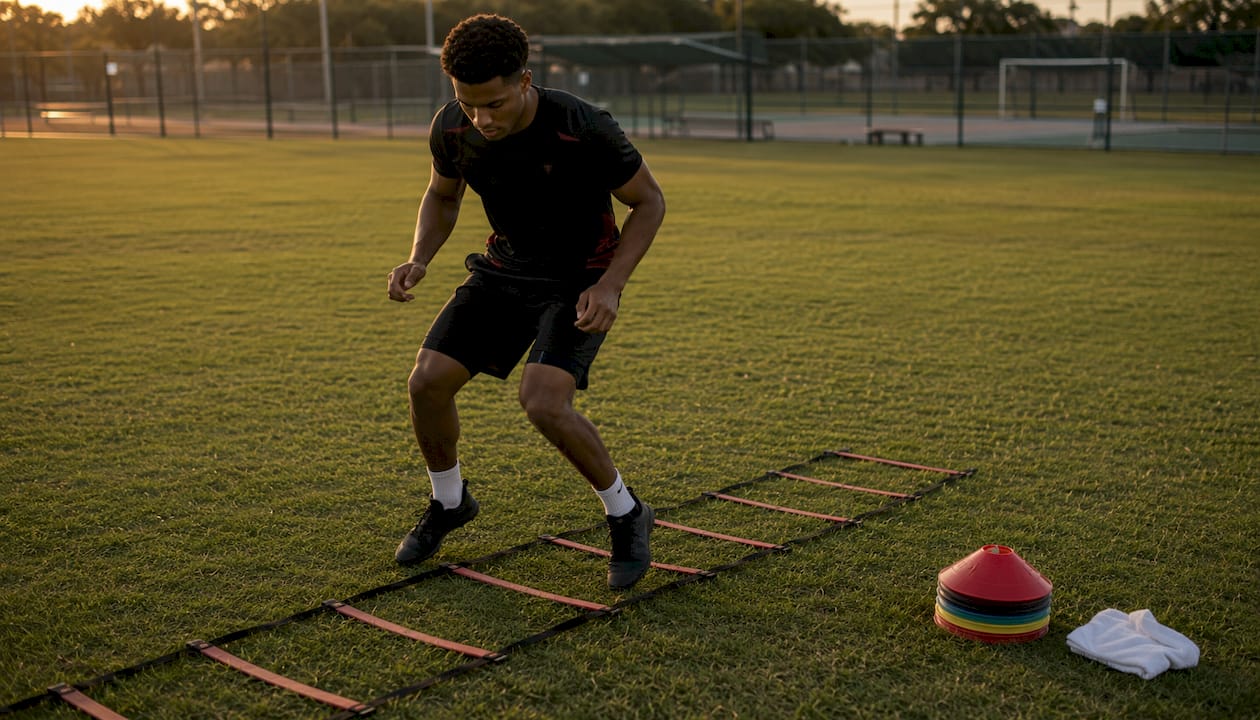
Agility ladders primarily train movement quality and neuromuscular coordination, not raw sprint speed. That distinction matters for how you program them. Use ladders to build footwork precision, rhythm, and cognitive-motor control; pair them with plyometrics or structured change-of-direction (COD) overload when your goal is measurable transfer to sprint performance or power output.
The short version for coaches and athletes:
- What ladders do well: Improve foot placement accuracy, inter- and intramuscular coordination, reactive attention, and low-level movement patterning.
- What they don’t do reliably alone: Produce large sprint-speed or jump-power gains without higher-load stimuli added to the program.
- Immediate coaching action: Treat ladders as a technical and neural tool. Keep sessions short, prioritize quality over speed, and combine with plyometric or COD overload drills when transfer to on-field speed is the objective.
Table of Contents
- What does agility ladder training actually develop?
- What does the research actually say about ladder training?
- Which ladder drills should you use, and how?
- How do you program ladder work into a weekly plan?
- Coaching cues that actually change movement
- When ladders aren’t enough and what to use instead
- Safety considerations and injury risk management
- How do you know if ladder training is actually working?
- How Bodiesbymahmood programs ladder work in practice
- Key Takeaways
- The ladder is a precision instrument, not a cardio machine
- Sport-specific agility training at Bodiesbymahmood
What does agility ladder training actually develop?
The honest answer is more specific than most coaches expect. Ladder drills target a cluster of neuromuscular and cognitive-motor qualities that matter enormously in sport, but they do so through a different pathway than sprinting or jumping.
Neuromuscular coordination. Patterned ladder drills force the nervous system to sequence foot contacts with precision and timing. That trains inter- and intramuscular coordination — the ability of muscle groups to fire in the right order, at the right moment, with the right force. It is the same quality that separates a fluid athlete from a stiff one.
Movement quality and rhythm. Ladders teach stride regulation, center-of-mass control, and the micro-deceleration/re-acceleration sequences that show up constantly in team sports. An athlete who can modulate their stride length and contact time inside a ladder pattern carries that skill into cuts and direction changes on the field.
Cognitive-motor elements. Complex ladder patterns load working memory. Add a partner cue, a ball, or a color-coded call and you layer reactive attention on top of the movement demand. Preliminary 2026 research found that agility training reduced Stroop incongruent response times and produced more economical prefrontal and premotor cortex recruitment during executive function tasks compared with resistance-aerobic training. That is a neural efficiency gain, not just a fitness gain.
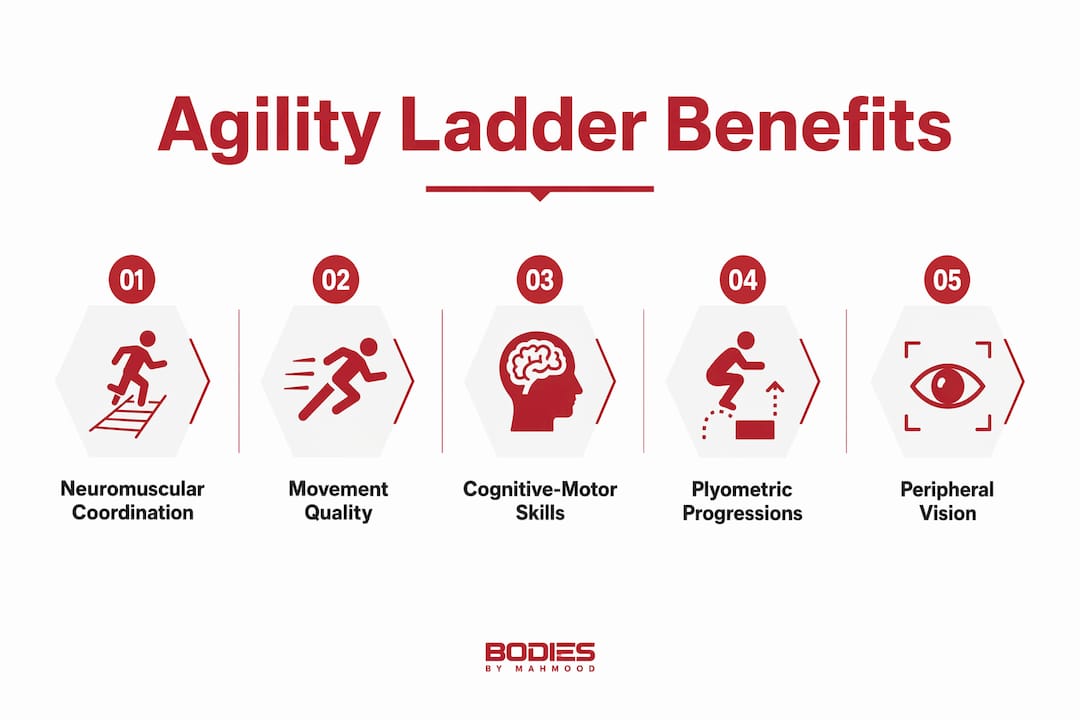
Proprioception and balance. Single-leg transitions and lateral hop patterns inside a ladder serve as low-level plyometric stimuli that challenge ankle and knee proprioception. For athletes returning from lower-limb injuries, this is genuinely useful.
What ladders do not primarily train:
- Maximal sprint velocity (requires near-maximal horizontal force application)
- High-force concentric power (requires heavy loading or explosive jump work)
- Heavy eccentric overload (requires plyometric depth or resisted deceleration work)
Ladder drills can be adapted into low-level plyometric progressions — ladder jacks and lateral hops are common examples — but execution and load must be carefully controlled to avoid practicing sloppy mechanics at the expense of real power development.
Pro Tip: Transition athletes from looking down at the ladder to maintaining peripheral vision within the first two sessions. Head-up practice is what makes ladder work resemble actual game demands rather than a floor-staring coordination exercise.
What does the research actually say about ladder training?
The evidence is more nuanced than either the “ladders are useless” crowd or the “quick feet = fast athlete” camp will admit.
Meta-analytic findings on SAQ training
A systematic meta-analysis of SAQ training found moderate, significant effects across several performance domains. The effect size for very short sprint performance (5 m) was approximately 0.63, lower-limb power came in at 0.96, and COD performance showed an effect size of roughly 0.39. Reaction time and flexibility also improved significantly, though with smaller magnitudes. Session duration at or below 60 minutes showed a near-significant advantage for COD outcomes in subgroup analysis.
Statistic callout: A SAQ meta-analysis reported a lower-limb power effect size of 0.96 and a 5 m sprint effect size of 0.63 — both moderate to large — but these figures reflect combined SAQ protocols, not ladder-only interventions.
That last qualifier is critical. Most SAQ studies bundle ladders, cone drills, reaction work, and sprint drills into a single intervention. Attributing the effect sizes entirely to the ladder is a methodological error coaches make constantly.
What ladder-only trials show
A 2020 PMC study on youth male soccer players (mean age 12.2 years) ran a 6-week, 18-session agility ladder protocol against a control group. Both groups improved on 10 m and 20 m sprint times, but between-group differences were not significant on any variable, including sprint, agility, or dribbling. The authors concluded that ladder training alone did not satisfy the load parameters needed to produce chronic adaptations beyond what regular soccer training already provides.
When combined protocols outperform
A 2024 randomized trial in young female volleyball players tested ladder-only, ladder plus plyometrics, and ladder plus multidirectional speed drills against a control. Only the ladder-plus-multidirectional group outperformed control on the agility T-test (P < .05). The ladder-alone group did not. That is a clean finding: the ladder was necessary but not sufficient.
Performance test data from the evidence base
| Outcome | Protocol | Effect Size | Practical Interpretation |
|---|---|---|---|
| 5 m sprint | SAQ combined | ~0.63 (moderate) | Meaningful for acceleration-dependent sports |
| Lower-limb power | SAQ combined | ~0.96 (large) | Driven largely by plyometric component |
| COD (T-test) | SAQ combined | ~0.39 (small-moderate) | Ladder + multidirectional drills needed for significance |
| Agility T-test | Ladder + multidirectional | Significant vs. control | Ladder alone did not reach significance |
| 10 m / 20 m sprint | Ladder alone (youth soccer) | Non-significant vs. control | No added benefit over regular training |
Methodological notes coaches should know: Most positive trials involve youth or adolescent athletes, short intervention windows (6–8 weeks), and combined protocols. Adult athletes with established movement patterns may see smaller gains. Sport-specific testing (dribble time, reactive COD) tends to show more transfer than generic sprint tests.
Which ladder drills should you use, and how?
The drills below are organized from foundational to complex. Teach the pattern first, then add speed, then add a reactive element.
Foundational drills with execution cues
- Two-foot run (basic ladder run): Both feet enter each rung sequentially. Cue: stay on the balls of the feet, keep hips low, arms drive in opposition. This is your baseline pattern check.
- In-and-outs (lateral): Both feet step outside the ladder, then back in, moving forward. Cue: keep the chest tall, don’t let the knees cave inward on the lateral step.
- Lateral shuffle: Move sideways through the rungs, one foot per rung. Cue: maintain a slight hip hinge, never let the feet cross, keep eyes forward.
- Single-leg hops: Hop through each rung on one foot. Cue: land softly on the ball of the foot, absorb with the ankle and knee, minimize ground contact time.
- Carioca (crossover run): Alternating crossover steps through the ladder moving laterally. Cue: rotate through the hips, not the shoulders; keep the head still.
- Ladder jacks: Both feet jump out to the sides of each rung simultaneously, then back in. Cue: this is a low-level plyometric — land quietly, control the landing before accelerating into the next rep.
Sport-specific progressions
Soccer: Run the lateral shuffle pattern, then explode into a 5 m sprint at the end of the ladder. Add a ball at the finish for a first-touch decision. This sequence mimics the accelerate-receive-decide pattern that happens dozens of times per match.
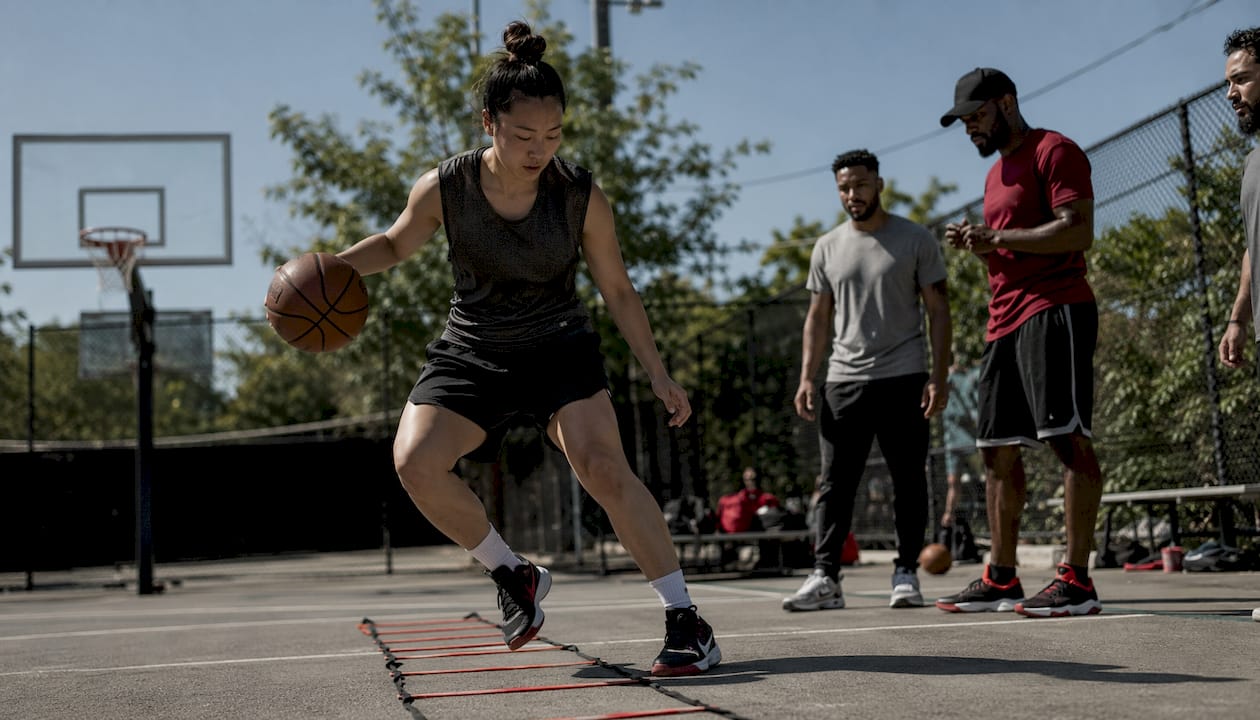
Basketball: Use the in-and-out drill with a ball-handling component — dribble with the outside hand while moving through the pattern. Adds perceptual load and forces the athlete to maintain head-up vision.
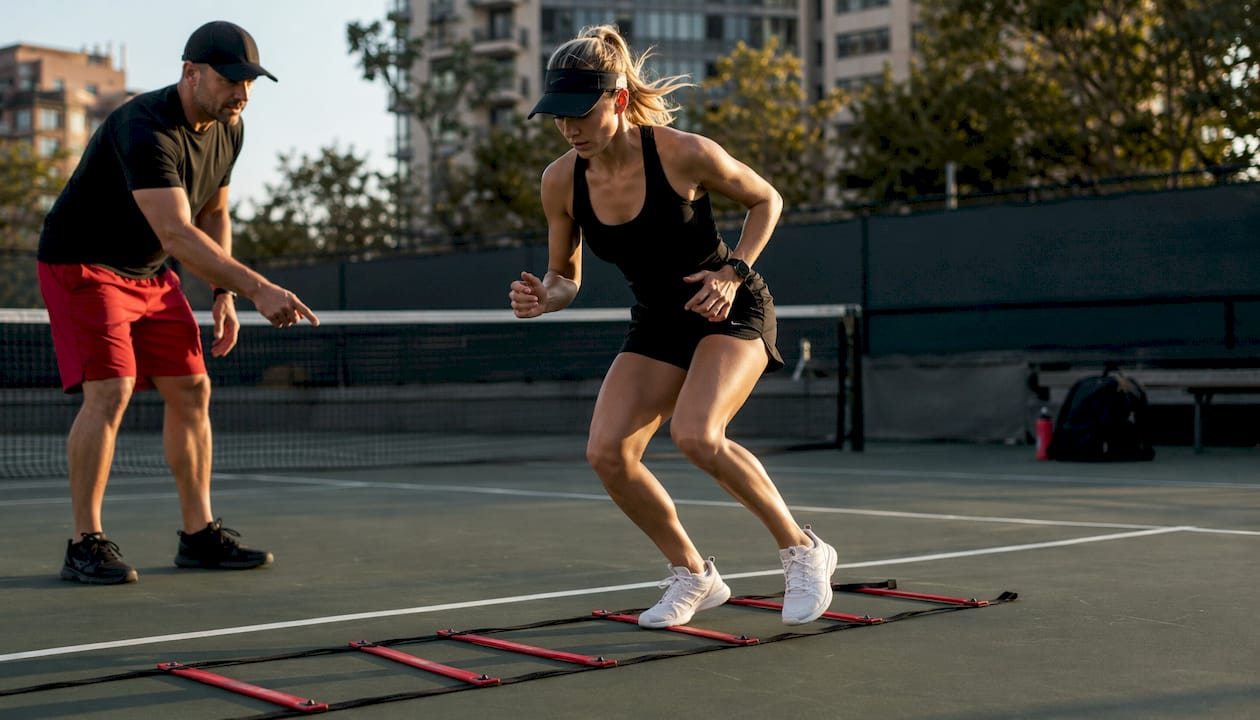
Tennis: Carioca through the ladder, then split-step and react to a coach’s directional cue at the exit. Trains the split-step timing that separates reactive movers from slow ones.
Volleyball: Single-leg hops followed immediately by a lateral shuffle to a blocking position. Reinforces the deceleration-to-lateral-movement pattern used at the net.
Combat sports: Two-foot run with directional changes called by the coach mid-drill. Trains footwork rhythm and reactive repositioning simultaneously.
Programming note: Use a few sets of each drill for short durations followed by brief rest periods to allow neural recovery. Place ladder work either in the warm-up (neuromuscular activation) or as a dedicated block before strength work, not after heavy lifting when fatigue compromises movement quality.
Pro Tip: Combine a carioca ladder exit with a reactive sprint to a cone called by color or number. This single drill hits footwork rhythm, reactive attention, and acceleration in one sequence — the closest thing to a sport-specific decision drill you can run with a ladder.
How do you program ladder work into a weekly plan?
Structure matters more than volume here. Two sessions per week is the standard recommendation for neuromuscular maintenance, and that holds whether you are training a high school soccer player or a competitive adult athlete.
Session placement options
- Warm-up block: 5–8 minutes of ladder drills before technical or tactical work. Activates the nervous system, reinforces movement patterns, and raises body temperature without creating fatigue that bleeds into the main session.
- Dedicated neuromuscular block: 10–15 minutes post-warm-up, pre-strength. Use this when coordination is the primary objective for the day.
- Pre-practice skill work: Combine ladder drills with ball work or sport-specific decision tasks. Best for in-season maintenance when training time is compressed.
Progression timeline
- Weeks 1–2 (technical mastery): Slow, deliberate execution. The athlete should be able to describe the pattern while doing it. No speed pressure.
- Weeks 3–6 (speed and complexity): Increase tempo incrementally. Add a second drill variation. Begin layering reactive cues at the end of each pattern.
- Weeks 6+ (reactive, sport-specific application): Full-speed patterns with partner or coach cues. Integrate with plyometric or COD overload drills in the same session.
Weekly programming table
| Week Block | Primary Objective | Drill Focus | Outcome Measure |
|---|---|---|---|
| 1–2 | Technical mastery | Two-foot run, in-and-outs, lateral shuffle | Pattern accuracy, head position |
| 3–6 | Speed and complexity | Carioca, single-leg hops, ladder jacks | Drill completion time, error count |
| 6+ | Reactive application | Sport-specific combos with reactive cues | T-test time, sport-specific skill test |
For athletes targeting sprint or jump improvements, combine ladder sessions with jump training in the same microcycle. The ladder handles neural patterning, while the plyometric work provides the mechanical overload that drives power adaptation.
Coaching cues that actually change movement
Good cues are specific, immediate, and tied to what the athlete can feel. Generic cues (“be quick,” “stay light”) produce generic results.
Priority cues by body segment:
- Head and eyes: “Pick a point on the wall and keep it in your vision.” This single cue corrects the most common error in ladder work — looking down.
- Feet: “Touch the ground like the floor is hot.” Encourages ball-of-foot contact and short ground contact times.
- Knees: “Soft knees on every landing.” Prevents the stiff-legged stomping pattern that loads the joints and slows transitions.
- Hips: “Stay in your athletic position — don’t stand up between rungs.” Hip height should remain relatively constant through the pattern.
- Arms: “Drive your elbows back, not across your body.” Arm action that crosses the midline creates rotational inefficiency.
Common mistakes and corrections:
- Looking down: Correct with an external focus cue (point on the wall, partner’s chest). Video feedback after the set is highly effective here.
- Overstriding: Athlete is reaching for the rungs instead of stepping quickly. Cue: “Smaller, faster steps.” Shorten the ladder spacing if needed.
- Uncontrolled crossovers in carioca: Usually a hip mobility or pattern issue. Slow the drill down two levels and rebuild from there.
- Rushing before pattern mastery: The most damaging error. Speed before quality ingrains poor motor habits that are genuinely difficult to unlearn. Eric Cressey’s recommendation to keep ladder work brief and quality-focused is well-grounded — less than five minutes of ladder-focused neuromuscular work per session is commonly advised.
Cue progression sequence: Verbal cue during the drill → tactile correction between sets → video review after the block → game-speed constraints once the pattern is clean.
Coach quality checklist: Before advancing speed, confirm the athlete can (1) complete the pattern without looking down, (2) maintain consistent foot placement across all rungs, (3) show no knee valgus on single-leg transitions, and (4) recover posture within one step of exiting the ladder.
Pro Tip: Film athletes from the side and from behind in the same session. The side view catches overstriding and vertical oscillation; the rear view catches knee alignment and hip drop. Two angles, one set, and you have everything you need to give precise feedback.
When ladders aren’t enough and what to use instead
Ladder drills have a ceiling. Knowing where that ceiling sits is what separates a well-designed program from one that looks busy but produces limited results.
Situations where ladders fall short:
- Maximal sprint velocity development: Sprinting at 95–100% of maximum speed requires near-maximal horizontal force application and full stride length. Ladder rungs constrain both. Assisted and resisted sprint work (sled pulls, bungee-assisted runs) is the appropriate tool here.
- High-force concentric power: Developing the explosive leg power needed for vertical jump or first-step quickness requires heavy loading or true plyometric overload. Ladder jacks and single-leg hops are low-level plyometrics at best.
- Heavy eccentric overload: Deceleration strength — the ability to absorb force rapidly during a cut — requires structured COD overload drills with meaningful approach speeds, not the slow-to-moderate speeds typical of ladder work.
- Sport-specific COD with full approach velocity: The PMC systematic review on pro-agility performance found that sprint training (ES 0.108 per session), plyometric training (ES 0.092), and resistance training (ES 0.087) all produced larger per-session effects on COD performance than ladder-based COD drills alone.
What to combine or substitute:
- Replace ladder-only sessions with ladder-plus-plyometric overload blocks when jump or sprint power is the goal.
- Add multidirectional sprint drills (60°, 90°, 180° cuts at near-maximal speed) to ladder sessions for COD transfer. The 2024 volleyball trial showed this combination outperformed control; ladder alone did not.
- For athletes who need athletic development across age groups, the ladder remains a useful coordination tool, but the load must scale with the athlete’s maturity and training age.
- Use unilateral resistance training to build the deceleration strength that ladder work cannot provide. Single-leg squats, Bulgarian split squats, and lateral step-downs address the force demands of 180° COD directly.
The ladder is a coordination tool. Treat it as one component in a system, not the system itself.
Safety considerations and injury risk management
Ladder drills are low-impact relative to sprinting or jumping, but “low-impact” does not mean “no risk.” Most ladder injuries come from poor surface conditions, fatigue-driven errors, or athletes advancing speed before they have the movement quality to support it.
Key injury risk factors:
- Prior ankle or knee injuries with incomplete proprioceptive recovery
- Poor landing mechanics (knee valgus, flat-footed contact, forward trunk collapse)
- Fatigue late in a session, when foot placement accuracy degrades
- Wet or uneven surfaces that shift the ladder mid-drill
- Rushing progressions in youth athletes whose motor patterns are still developing
Safe implementation protocols:
- Always perform a general warm-up (5–10 minutes of low-intensity movement) before ladder work. Cold muscles and cold nervous systems do not pattern well.
- Follow the Nike-recommended dosing: 20–30 seconds per drill, 10–20 seconds rest between drills, 2–3 minutes between sets for neural recovery.
- For youth athletes, keep total ladder volume under 10 minutes per session and emphasize pattern accuracy over speed throughout the entire developmental period.
- For athletes returning from ankle or knee injuries, begin with two-foot bilateral drills on a flat, non-slip surface. Progress to single-leg patterns only after demonstrating stable, controlled landings. Pair this phase with a flexibility and injury prevention protocol to address mobility deficits before adding speed.
- For older adults, ladder work combined with strength training can improve gait speed, balance, and cognitive reaction time, but the surface must be stable and a spotter should be present during early sessions.
Session safety checklist:
- Surface is flat, dry, and free of obstructions
- Ladder is secured at both ends or weighted to prevent shifting
- Athletes have completed a full warm-up
- Athletes can demonstrate the drill pattern at slow speed before tempo increases
- Coach is positioned to observe foot placement and knee alignment throughout
How do you know if ladder training is actually working?
The answer is not “they look faster.” You need a testing protocol with pre- and post-measures tied to the specific qualities ladder work targets.
Recommended tests and what they measure
- 5 m and 10 m sprint splits: Measure acceleration. Use timing gates, not stopwatches. Minimum detectable change for well-trained athletes is approximately 0.05 seconds at 10 m.
- T-test (agility): Measures COD speed and lateral movement quality. A reliable, widely used field test. Expect small improvements (0.2–0.5 seconds) after combined ladder-plus-multidirectional protocols over 6–8 weeks.
- 505 COD test: Isolates 180° change-of-direction ability. More specific than the T-test for sports with frequent 180° cuts (basketball, tennis).
- Reactive choice drill: Athlete responds to a visual or auditory cue and sprints to a designated cone. Measures cognitive-motor integration — the quality most directly trained by ladder work with reactive elements.
- Sport-specific skill measures: Dribble time through a cone course, passing accuracy under time pressure, or serve-return reaction time. These are the outcomes that actually matter for the athlete’s sport.
Pre/post testing protocol
| Test | Attribute Measured | When to Test | Expected Change (Combined Protocol) |
|---|---|---|---|
| 5 m sprint | Acceleration | Pre, post 6 weeks | Small to moderate (ES ~0.63 in SAQ meta-analysis) |
| T-test | COD speed | Pre, post 6 weeks | Small to moderate (ES ~0.39 in SAQ meta-analysis) |
| 505 COD | 180° COD ability | Pre, post 8 weeks | Small (ladder alone); moderate (ladder + multidirectional) |
| Reactive choice drill | Cognitive-motor speed | Pre, post 6 weeks | Moderate (agility training shows neural efficiency gains) |
| Sport-specific skill | On-field transfer | Pre, post 8 weeks | Variable; most sensitive to combined protocols |
Control for practice effects by using the same warm-up protocol before every test session and testing at the same time of day. For youth athletes, account for maturation — a 12-year-old who improves over 8 weeks may be responding to growth as much as training. For sport performance testing guidance on selecting and interpreting these measures, a structured protocol makes the difference between data and noise.
Interpretation guidance: After a ladder-only protocol, expect small improvements on COD tests and minimal change on sprint or power measures. After a combined ladder-plus-plyometric or ladder-plus-multidirectional protocol, expect small to moderate improvements across sprint, COD, and reactive measures. If you see no change after 6 weeks of combined work, the issue is usually insufficient intensity, poor technique, or a testing protocol that doesn’t match what was trained.
How Bodiesbymahmood programs ladder work in practice
At Bodiesbymahmood in Orlando, ladder drills are never the centerpiece of a session. They are a precision tool within a larger sport-specific program, used to establish movement quality before higher-load work begins.
A typical session structure looks like this: a 5-minute general warm-up, followed by an 8–10 minute ladder block focused on two or three drills at technical speed, then a transition into plyometric pairings or COD overload work. The ladder block sets the neural tone for the session; the plyometric or sprint work provides the mechanical stimulus that drives adaptation. Trainers monitor session RPE and movement quality throughout, and they pull back on speed the moment foot placement or posture degrades.
Progress markers used at the facility include pattern accuracy (can the athlete complete the drill without errors at 80% speed?), head position (are they maintaining peripheral vision?), and exit quality (do they accelerate cleanly out of the last rung?). These are observable, coachable, and directly tied to what the ladder is supposed to develop.
For aging athletes and those focused on longevity, Bodiesbymahmood incorporates ladder-based coordination work within broader programs that include strength and balance training. The active aging fitness guide covers how these principles extend to older populations where gait speed and fall-risk reduction are the primary outcomes.
The agility in sport performance overview from TeamJHall provides a useful complementary framework for coaches who want to situate ladder work within a broader agility development model.
Key Takeaways
Agility ladders are a neuromuscular coordination tool that produce measurable COD and cognitive-motor gains when combined with plyometric or multidirectional speed drills, not when used in isolation.
| Point | Details |
|---|---|
| Ladders train coordination, not speed | Use them for footwork precision and neural patterning; add plyometrics or sprint work for power and speed transfer. |
| Combined protocols outperform ladder-only | The 2024 volleyball trial showed only ladder-plus-multidirectional drills outperformed control on the agility T-test. |
| Program 2x per week, quality first | Follow short drill periods with brief rests; never advance speed before pattern mastery is confirmed. |
| Test with T-test and sport-specific measures | Pre/post COD and reactive choice tests reveal transfer; sprint-only tests often miss the gains ladder work produces. |
| Bodiesbymahmood approach | Ladder blocks are paired with plyometric and COD overload work in sport-specific sessions at the Orlando facility. |
The ladder is a precision instrument, not a cardio machine
Most coaches who underuse ladders do so because they’ve seen them misused. The athlete sprinting through the rungs as fast as possible, looking at the ground, stomping flat-footed — that drill is teaching bad mechanics at speed, which is worse than not training at all. The coaches who dismiss ladders entirely have usually watched exactly that.
The research supports a narrower, more deliberate use case. Ladders improve reactive cognitive control, foot placement precision, and movement rhythm. They do not replace sprint work, plyometrics, or strength training. They sit alongside those methods as the coordinative layer that makes the other work more transferable to sport.
What coaches repeatedly get wrong is the sequencing. They introduce ladder drills at game speed before the athlete has internalized the pattern at slow speed. The result is a fast, sloppy movement that the nervous system encodes as the correct version. Slow it down first. Teach the pattern until it is automatic. Then add speed. That sequence is not complicated, but it requires patience that most training environments don’t reward.
At Bodiesbymahmood, the philosophy is simple: the ladder earns its place in a program by improving what the athlete does after the ladder. If the COD test isn’t moving, the reactive drill isn’t cleaner, and the sport-specific skill isn’t sharper, the ladder block gets restructured or replaced. That standard keeps the tool honest.
Sport-specific agility training at Bodiesbymahmood
Athletes and coaches who want ladder work that actually transfers to on-field performance need more than a drill list. They need a program built around their sport, their movement deficits, and their competitive calendar.

Bodiesbymahmood’s personal training programs in Orlando are built exactly that way. With over 25 years of experience in sport-specific training, the facility’s coaches assess movement quality first, then build a microcycle that pairs ladder coordination work with plyometric overload, COD drills, and strength training in the right sequence for each athlete’s goals. You get the individualized attention of a private training environment with the resources of a full sport-performance facility.
Whether you are a coach looking to implement a structured agility block for your team or an athlete who wants to close the gap between coordination work and on-field speed, the starting point is a sport-specific assessment. Book a session at Bodiesbymahmood and get a program designed around what you actually need to improve.